Publications
Atlas of Environmental Data. 2023 edition
The Atlas of environmental data, a volume that ISPRA publishes for the first time, offers an overview of the main environmental data. It provides cartographic representations showing the spatial distribution of the main environmental information which, together with graphs, tables and texts, illustrate the state of the entire national territory.
Environment in Italy: an overview. Environmental Data Yearbook 2022
Environment in Italy: an overview. Environmental Data Yearbook 2022 is a statistical report produced by ISPRA with the aim of providing policy makers, public administrators, technicians and citizens with official information on the state of the environment in our country.
UAV-based high-resolution mapping of a complex landslide: an example from Basilicata, southern Italy
RaStEM: a tool to support planning and design of hydrogeological risk mitigation measures
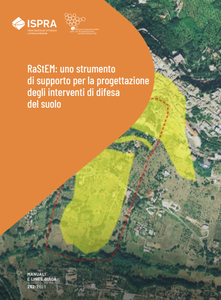
The monitoring of hydrogeological risk mitigation measures, that ISPRA has been carrying out for more than twenty-five years on behalf of the Ministry of the Environment and Energy Security (MASE), highlights that in many cases measures planning and design does not take into account adequately the typological characteristics of the hazards and the relationships between them and the elements exposed to risk in the area
Application of isotopic analysis for the proportioning of organic matter: study of an artificial reservoir
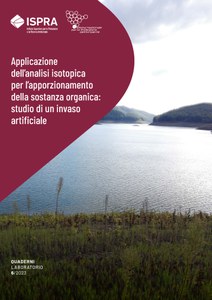
With the study of the stable isotopes of carbon and nitrogen it is possible to quantify the contribution to the total organic substance deriving either from the natural transformation of the biotic component or from anthropic sources such as, for example, urban and/or industrial waste. Recent research has demonstrated the effectiveness of such investigations in the identification and evaluation of contributions to organic matter deriving from multiple sources, in fact the stable isotopes of carbon and nitrogen show an isotopic composition characteristic of the source from which they originate.
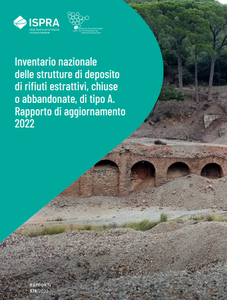
National inventory of closed or abandoned type A mining waste storage facilities. Update report to 2022
Stratigraphy and facies of the Apennine Carbonate Platform (southern Italy): the record of Mesozoic OAEs and Miocene transgression
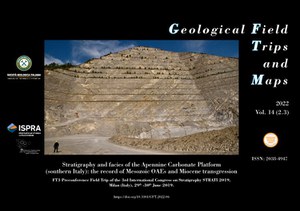
FT3 Preconference Field Trip of the 3rd International Congress on Stratigraphy STRATI 2019, Milan (Italy), 29th -30th June 2019
Geological Map of Italy at 1:50,000 scale - Updating and supplementing the guidelines of the Geological Map of Italy at 1:50,000 scale (Version 1.0/2022)
Days of Geology and History December 2021/June 2022
The Yearbook in figures
Environmental Data Yearbook 2021
Walking through the environment

Risk assessment criteria for priority setting of the remediation interventions
ISPRA, as required by the legislation (Art. 199 - paragraph 6, letter a) of Legislative Decree 152/06), has started the activities of developing risk assessment criteria as a national reference for the Regional Plans for the Remediation of Polluted Areas (PRBs). This report illustrates the activities conducted in the first phase (phase 1), in which national priority criteria are first identified, to apply to potentially contaminated sites, with the support of the Technical Table, set up with Regions and ARPA, starting with the reconnaissance of criteria available at national and international level.
Landslides and floods in Italy: hazard and risk indicators – 2021 Edition
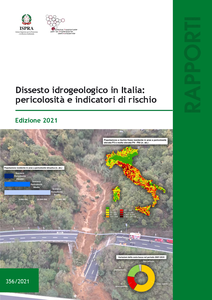
The 2021 edition of the Report, the third dedicated to this topic, provides the updated overview on landslide and flood hazard, coastal erosion in Italy and presents the risk indicators related to population, families, buildings, industries and services, and cultural heritage.
Open Ecological Transition
The Yearbook in figures
Environmental Data Yearbook 2020
Models of flow and transport of contaminants in groundwater
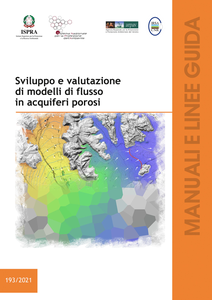
The implementation of numerical models of flow and transport of contaminants in groundwater is becoming increasingly important, either in the context of remediation procedures for contaminated sites with the purpose of defining and planning interventions for the safety and remediation of groundwater, and at the basin or sub-basin scale for the characterization and management of groundwater resources. In this context, it is of primary importance that public administrations and control bodies, as auditors or reviewers of the models themselves, have a methodological reference that guides the implementation on the one hand, and the evaluation of numerical models on the other.
Status of contaminated sites management in Italy: regional data
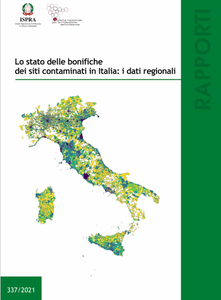
The first report on the contaminated sites management at regional level is a result of the cooperation between SNPA and Regions/Autonomous Provinces and provides an overview of the existing information and the analysis of the available data at present.
Indications for the safety of disused mining site
Publication by REMI
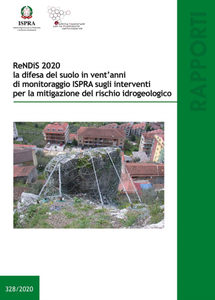
Report ReNDiS2020: land protection through twenty years of ISPRA monitoring of measures for the mitigation of hydrogeological risk
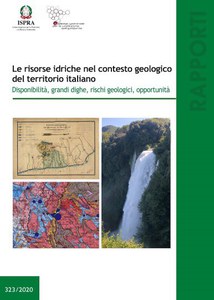
Report "Water resources in the geological context of the Italian territory. Availability, large dams, geological risks, opportunities"
Environmental Data Yearbook - Edition 2019
Data on the Environment
Environmental Data Yearbook 2019
Environmental Data Yearbook in numbers

Environmental Data Yearbook 2019
Italian environment. Trend and Legislation
Environmental Data Yearbook 2019
Summarising...the environment
Environmental Data Yearbook 2019
Geological Map of Italy at 1:50,000 scale: geothematic cartography of the sheet 348 Antrodoco
Pesticides in water – Italian monitoring 2016
Reticula n.17/2018
Explanatory Notes of the sheet 070 Monte Cervino of the geological Map of Italy at 1:50,000 scale
The groundwater and the seawater intrusion in Apulia: from research to the emergency in the safeguard of the water resource