
Transitional waters
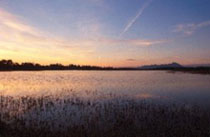
Coastal brackish waters are part of transitional coastal areas, where freshwater from the land and saltwater from the sea mix, constituting the natural transition between land and sea; due to their location, at the boundary between these two environments, they are considered unique and highly productive ecosystems around which numerous human activities revolve.
Different types of transitional environments can be broadly classified as coastal lagoons, brackish ponds, estuarine zones, and other habitats.
Coastal lagoons, such as the Venice Lagoon, have been formed by the action of rivers transporting large amounts of sediment and currents depositing them horizontally and parallel to the coast, forming a littoral barrier (a set of shores) that encloses a stretch of water separated from the sea, into which both coastal and continental waters penetrate; it is dominated by tides, as it communicates with the sea through some openings or lagoon mouths.
Coastal ponds, like Orbetello, are coastal water bodies, with a mixture of fresh and marine waters, separated from the sea by a strip of land (littoral barrier, beach ridge, mass of sand, etc.), which sometimes communicate with the sea through narrow channels; these are characterized by shallow depths and, unlike lagoons, do not feel the influence of tides despite having outlets to the sea.
Other environments include drainage channels, sheltered bays, and mouths of temporary rivers.
Estuarine zones are those where river waters joining the sea are influenced by tides with progressive mixing and the presence of salinity and density gradients; the difference in density between freshwater and seawater due to gravity produces a vertical stratification of salinity and a convective flow (estuarine circulation).The variability of physic-chemical, climatic, and morphological parameters among environments belonging to the same typology is such that each area constitutes a unique environment with peculiar characteristics that are difficult to generalize and classify.
Coastal lagoons are very complex environments to analyze because there are numerous factors that contribute to making these environments highly variable; the morphology of each individual area is influenced by annual, seasonal, and even daily variations, both climatic (humidity, rainfall, temperature, winds) and physic-chemical (salinity, oxygen, ionic composition). These elements, in turn, influence each other, defining particular conditions of spatial and temporal heterogeneity in the same areas; numerous gradients are thus created, such as the salinity gradient with higher salinity towards the sea and lower salinity moving towards the interior of the basin; the variation is then more or less pronounced depending on the morphology of the basin and the presence or absence of rivers and outlets to the sea.
This high variability produces richness and diversity of habitats and biocenoses and an environment so productive that it is used by permanent and migratory species as nurseries, for the protection they offer and the abundance of food found there. The presence of large biomass with high primary and secondary production makes these environments economically important from the anthropic point of view for fishing, aquaculture, and other activities.
Fragile environments, to be protected
Transitional waters, precisely because of their great variability and the presence of different gradients, are very fragile and easily subject to dystrophic crises; these represent the most serious level of a long process that begins with high primary productions and vegetal biomass, high oxygen consumption, until reaching complete anoxia with the production of hydrogen sulfide and widespread deaths of species in all habitats present. Generally, this happens as a synergistic effect of a set of conditions, which occur during the summer season and in basins with shallow depths, such as high temperatures and water stagnation due to poor water exchange. Despite this fragility, such brackish areas have the ability to return, as the above-described factors vary, to the initial conditions, demonstrating to be ecosystems with a certain resilience (i.e., the ability of an ecosystem to restore initial conditions quickly after undergoing disturbances even of considerable magnitude) and a basic stability also due to the physiological adaptations of the species that populate them.
The species selected for brackish areas are those capable of withstanding stress well and are both exclusive characteristics of these ecosystems and populations of species belonging to the marine or freshwater environment that have developed particular adaptations to these conditions.
In cases of environmental stress, such as poor management or excessive exploitation of these environments, excessive sedimentation, sea level rise, and dystrophic crises, there is a qualitative decrease in species with a loss of biodiversity and an exponential increase in individuals of the same species. Unregulated exploitation can lead to increased salinization of water and surrounding land both due to uncontrolled extraction of water for agricultural irrigation, resulting in the influx of seawater through filtration, and due to the use of fertilizers in irrigation water that become enriched with organic matter.
To limit such loss of biological diversity, that has occurred in the past both due to degradation and disappearance of brackish areas, an international convention was launched in 1971, the Ramsar Convention, whose purpose is precisely the protection of wetlands from excessive exploitation. One of the areas included in the lists of this Convention is that of the Pontine Lakes (Sabaudia, dei Monaci, Caprolace, and Fogliano), already belonging to the Circeo National Park, in Latium. Other wetland areas of interest in Italy, part of the present 150,000 hectares of lagoon environments, are always in Latium in the Fondi Plain the Lake Lungo and Lake of Fondi, in addition to the protected areas of Burano and Orbetello, the Venice Lagoon, those of Grado and Marano and many others.
In recent years in Italy and in Europe, the importance of these environments has been understood, included at the national level in the new Italian water legislation (Legislative Decree 152/99) and at the European level in the Water Framework Directive (2000/60/Ce), in which an action is provided for controlling the environmental quality of such areas and regulating human activities with an impact on these environments.