
Publications
Italian Greenhouse Gas Inventory 1990-2021. National Inventory Report 2023
The report describes the reporting of emissions of greenhouse gases that Italy officially communicates in accordance with the requirements of the United Nation Convention of Climate Change (UNFCCC), the Kyoto Protocol, and the European Union’s Greenhouse Gas Monitoring Mechanism.
Italian Greenhouse Gas Emissions: emissions reduction target and scenarios

The report describes the greenhouse gas emissions and removals in Italy, based on the data officially transmitted in accordance with the provisions of the United Nations Framework Convention on Climate Change (UNFCCC), and the Mechanism of Greenhouse Gas Monitoring of the European Union.
Italian Emission Inventory 1990-2021. Informative Inventory Report 2023
The report describes the reporting of emissions of transboundary substances that Italy officially communicates in accordance with the requirements of the United Nations Economic Commission for Europe Convention on Long Range Transboundary Air Pollution (CRLTAP/UNECE) and relevant Protocols.
Bulletin on research funding

COP15: historical global deal for nature and people
The Yearbook in figures
Environmental Data Yearbook 2021
Methane in the Italian greenhouse gas Inventory L’Italia e il Global Methane Pledge
Climate indicators in Italy 2021 - Edition XVII

The 17th report "Gli Indicatori del Clima in Italia" describes the Italian climate in the year 2021 and updates the estimate of climate variations in the last few decades. It is based on climate data, indices and indicators derived from the "National System for the collection, processing and dissemination of climate data" (SCIA, www.scia.isprambiente.it ) developed by ISPRA in collaboration with National System of Environmental Protection national and regional meteorological monitoring networks.
Temperature and precipitation 1991-2020 climatic normals over Italy

Climate normals are the mean or characteristic values of a climate variable in a long time interval. The World Meteorological Organization (WMO) established that the length of the reference period should be 30 years, recommending to update the normals every 10 years, in order to provide representative reference values for recent climatic conditions.
The disaggreagation at the provincial level of the national inventory of emissions
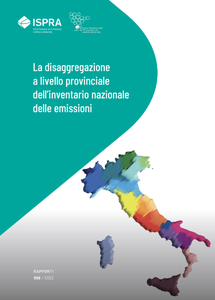
This report illustrates the activity carried out to disaggregate on a provincial basis the emissions of pollutants and greenhouse gases estimated in the national emissions inventory prepared by ISPRA. The estimates were obtained using a top-down approach and calculated for the years: 1990 - 1995 - 2000 - 2005 - 2010 - 2015 - 2019.
Efficiency and decarbonization indicators for total energy consumption and power sector. Comparison among Italy and the biggest European countries
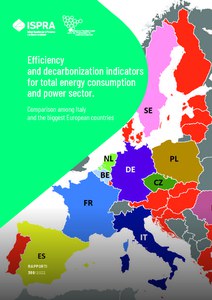
Efficiency and decarbonization indicators updated to 2020 have been analyzed in relation to energy consumption and greenhouse gas emissions. The 2020 is the benchmark year to verify the EU's climate and energy targets established with the Climate and Energy Package. Moreover, in 2020 the Covid-19 emergency has heavily affected the European countries’ economy and GHG emissions.
Italian Greenhouse Gas Inventory 1990-2020. National Inventory Report 2022
The report describes the reporting of emissions of greenhouse gases that Italy officially communicates in accordance with the requirements of the United Nation Convention of Climate Change (UNFCCC), the Kyoto Protocol, and the European Union’s Greenhouse Gas Monitoring Mechanism.
Italian Greenhouse Gas Emissions at the end of Kyoto Protocol second commitment period: emissions reduction target and energy efficiency
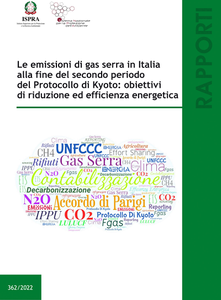
The report describes the greenhouse gas emissions and removals in Italy, at the end of the second period of the Kyoto Protocol, based on the data officially transmitted in accordance with the provisions of the United Nations Framework Convention on Climate Change (UNFCCC), the Kyoto Protocol and the Mechanism of Greenhouse Gas Monitoring of the European Union
Efficiency and decarbonization indicators in Italian energy and power sector
National trends of energy and economic indicators have been analyzed in relation to greenhouse gas emissions and energy consumption. Particular attention was paid to the electricity sector, one of the main players in the national energy system. The role of factors determining greenhouse gas emission trends has been analyzed, such as economic growth, fossil and renewable fuels composition, transformation efficiency, and fossil fuel emission factors. With regard to electricity sector, the emission factors of greenhouse gases and other atmospheric contaminants have been elaborated.
EMAS and climate change
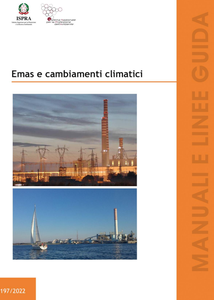
This guideline takes the reader through the topic of climate change and its close interconnection with emission sources. Starting with the “Environmental Statements” of a sample of EMAS-certified power plants which produce electrical energy from fossil fuels it examines the CO 2 , NOx, CO and SO X emissions produced in the period between 2011 and 2019. The results show how the energy sector, thanks to the implementation of an Environmental Management System, can correctly manage air emissions and continuously improve on them.
Open Ecological Transition
Emissions Trading Scheme in Italy and in the biggest European Countries
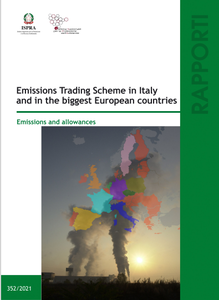
The report analyses the GHG emissions from the stationary installations belonging to the EU emissions trading system (EU-ETS). The analysis of energy consumption has been carried out for the Italian activity sectors. The results show the decrease of emissions from ETS sectors since 2005 and the decreasing emission factors for many sectors mainly due to the increasing share of natural gas and bioenergy, mostly in the power sector.
Climate indicators in Italy 2020 - Edition XVI
The 16th report "Gli Indicatori del Clima in Italia" describes the Italian climate in the year 2020 and updates the estimate of climate variations in the last few decades. It is based on climate data, indices and indicators derived from the "National System for the collection, processing and dissemination of climate data" ( SCIA ), developed by ISPRA in collaboration with national and regional meteorological monitoring networks.
Efficiency and decarbonization indicators for total energy consumption and power sector. Comparison among Italy and the biggest European countries
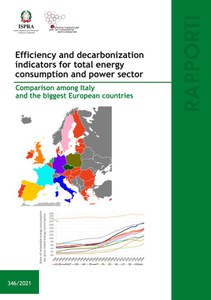
Efficiency and decarbonization indicator trends have been analyzed in relation to energy consumption and greenhouse gas emissions. Italian indicators are compared with those of the largest European countries.
Efficiency and decarbonization indicators in Italian energy and power sector
Proposed indicators for domestic MRV purposes and tracking progress of NDCs
The overall objective of this report is to provide countries with relevant examples of indicators, which may be used in pursuing domestic monitoring tasks as well as in reporting on progress towards implementation and achievement on Parties’ NDCs.
Italian Greenhouse Gas Inventory 1990-2019. National Inventory Report 2021
This document summarizes the official Italian submission of the greenhouse gas inventory in the framework of the United Nation Convention of Climate Change (UNFCCC), the Kyoto Protocol, and the European Union’s Greenhouse Gas Monitoring Mechanism.
Italian Emission Inventory 1990-2019. Informative Inventory Report 2021
The document describes the annual communication of the national emission inventory of transboundary substances in the framework of the United Nations Economic Commission for Europe Convention on Long Range Transboundary Air Pollution (CRLTAP/UNECE) and relevant Protocols
Status and trend of the main allergenic pollens in Italy (2003-2019)
Eu-Ets in Italy and main European countries
Reticula n. 24/2020

Climate indicators in Italy, 2019 - Edition XV
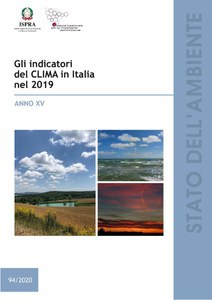
Year XV
Environmental Data Yearbook - Edition 2019
Data on the Environment
Environmental Data Yearbook 2019
Environmental Data Yearbook in numbers

Environmental Data Yearbook 2019
Italian environment. Trend and Legislation
Environmental Data Yearbook 2019