
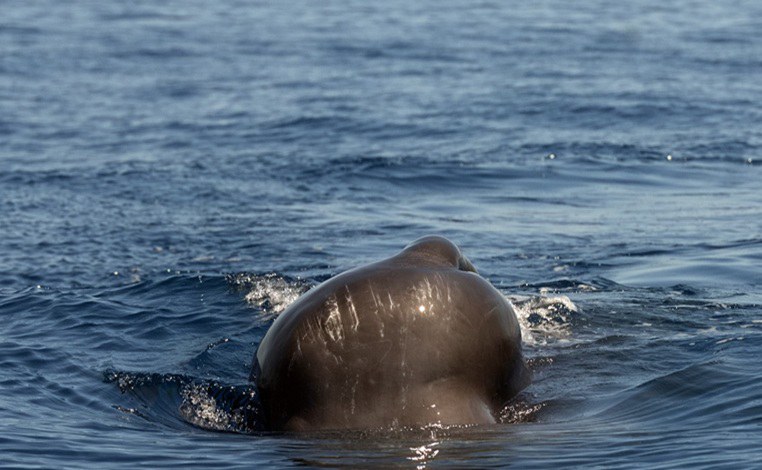
A New Key Area for Sperm Whales in the Aegean Sea
An important achievement resulting from ISPRA’s activities within the LIFE MARENATURA project, which dedicates one of its Work Packages to studying the habitat use of the sperm whale (Physeter macrocephalus).
In May 2026, aboard the research vessel Artina operated by Nature Conservation Consultants (NCC), ISPRA, with the support of the CIMA Research Foundation, coordinated a field campaign to deploy SPOT-365 satellite tags. Thanks to the outstanding joint efforts of the LIFE MARENATURA project partners, more than 80 hours of observation were carried out during just 10 days of surveys, leading to the sighting of three adult male sperm whales.
All three animals were successfully equipped with satellite transmitters. The results are highly significant both in terms of transmission duration and habitat use. One tag transmitted data for approximately 14 days, a second for more than one month, while the third is still active, continuously recording the animal's movements since 8 May 2026 (see attached map). This represents one of the longest satellite tracking records ever obtained for a sperm whale in the Mediterranean. Moreover, the data reveal an unexpected intensive use of the Aegean Sea compared with the better-known Hellenic Trench area.
The identification of a new area used by sperm whales represents a major advance for the conservation of this species, which is classified as Endangered in the Mediterranean. At the same time, this discovery highlights the need for further research in this region, which coincides with one of the main shipping corridors in the eastern Mediterranean, crossed daily by cargo vessels travelling to and from the Black Sea. Understanding how sperm whales use this habitat will be essential for assessing the risks associated with ship strikes and underwater noise, and for developing effective mitigation measures.
This achievement demonstrates how the collaboration among the LIFE MARENATURA project partners is transforming scientific research into practical tools for the conservation of marine biodiversity and for the increasingly sustainable management of the Mediterranean Sea.
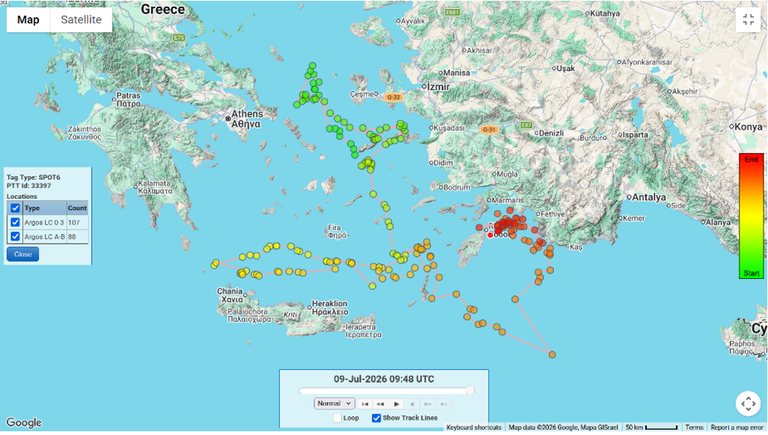
The track followed by the tagged individual (colour gradient from green to the most recent locations shown in red).