
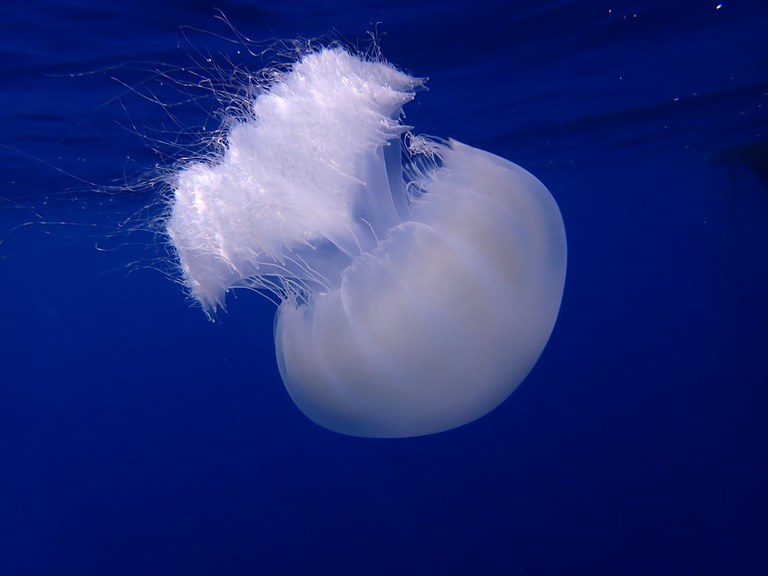
Don't Touch the Nomad Jellyfish!! A Particularly Nasty Stinging Alien Invading Our Seas
Sightings are on the rise, with Sicily under close observation
ISPRA calls on citizens, fishermen and marine professionals to help monitor the species
An increasingly common presence in Italian waters is the nomad jellyfish (Rhopilema nomadica), native to the Red Sea and the Indo-Pacific region. It entered the Mediterranean through the Suez Canal and is now the subject of a growing number of reports along the Italian coastline.
Since then, the species has progressively expanded its range throughout the Mediterranean basin. In Italy, the first documented sighting dates back to September 2015, in the waters off Pantelleria.
More recently, reports have been received from numerous locations in Sicily, including Trapani, the Egadi Islands, Ustica, Lampedusa, Cefalù, the Gulf of Castellammare and Palermo. The sightings involve both individual specimens and groups of jellyfish, highlighting the importance of remaining vigilant about the species' presence and distribution.
The nomad jellyfish can reach considerable dimensions, weighing up to 40 kilograms, and can form aggregations of hundreds or even thousands of individuals. Its presence can have consequences for human activities connected with the sea: specimens can become entangled in fishing nets, disrupt fishing operations and affect the use of beaches and seaside tourism facilities. Particular care should be taken to avoid contact with its stinging tentacles, which can cause significant skin reactions. The recommendation is simple: never touch these jellyfish, even when they have washed ashore.
Every sighting can make a difference, and the contribution of those who live by the sea or spend time there is invaluable. ISPRA thanks citizens, fishermen, recreational boaters, divers and maritime industry professionals who contribute to its monitoring activities. If you spot a specimen, it is important to take a photograph or video without approaching or touching it, and send the report, specifying the date and location of the sighting, to alien@isprambiente.it.
Maria Alessandra Gallone, President of ISPRA and SNPA, said: “Every piece of information collected helps expand our knowledge of the species' distribution and strengthen our ability to observe and protect marine ecosystems. The contribution of citizens, fishermen and everyone who lives and works at sea is essential: every sighting can provide valuable information for scientific research. Protecting the sea begins with understanding it: cooperation between the scientific community and citizens is an essential resource for safeguarding biodiversity and addressing the changes taking place with greater awareness, because the sea is a shared heritage. Understanding it, observing it and monitoring it are everyone's responsibility"