Greenhouse Gas Emissions and Air Pollutants in Italy
In 2024, emissions down 30% from 1990; fewer air pollutants thanks to energy efficiency and renewables
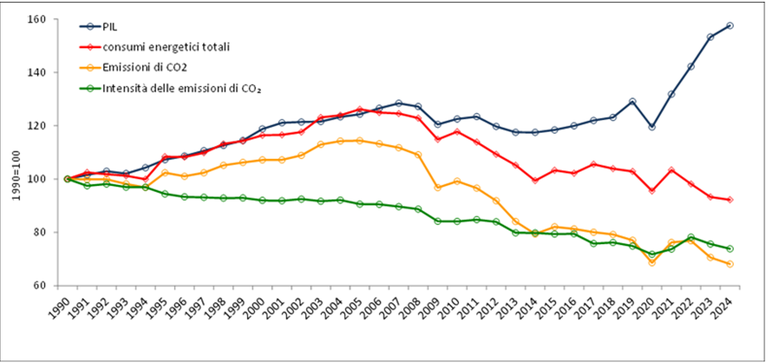
In 2024, national greenhouse gas emissions show a 30% reduction compared to 1990 levels and a 3.6% decrease compared to 2023, amounting to just over 360 million tonnes of CO₂ equivalent. This result is linked to the growing spread of renewable energy sources—particularly hydropower and wind energy—improvements in energy efficiency, and the gradual replacement of more carbon-intensive fuels with lower-carbon alternatives.
For 2025, however, a slight increase in emissions (0.3%) is expected, mainly due to greater reliance on natural gas for electricity generation, also in connection with a reduction in hydropower production. Emissions associated with coal use continue to decline, in line with decarbonization targets.
These are some of the data processed by ISPRA as part of the National Greenhouse Gas Emissions Inventory and the Air Pollutant Emissions Inventory, submitted to European and international bodies, in particular the United Nations Framework Convention on Climate Change (UNFCCC) and the United Nations Economic Commission for Europe (UNECE).
All information and related documents are available on the Emissions website.
Not all sectors show a reduction: emissions from transport—responsible for 31% of the national total and more than 90% linked to road transport—continue to rise and are more than 10% higher than in 1990. Together with transport, the sectors of energy production (18%), residential (18%), and manufacturing industry (13%) collectively account for around 80% of national emissions.
Since the early 2000s, a gradual decoupling between economic growth and CO₂ emissions has been observed: after a brief post-pandemic rebound, emissions have returned to declining while GDP continues to grow, reinforcing this trend.
Significant reductions have also been recorded for air pollutants between 1990 and 2024, thanks to energy efficiency, renewable energy, technological innovation, stricter emission limits, and cleaner fuels. These include:
- Sulphur oxides −96%
- Nitrogen oxides −75%
- Carbon monoxide −77%
- Black carbon −67%
- Cadmium −64%
- Mercury −65%
- Lead −96%
The energy sector remains the main source of emissions for many pollutants (over 80%), while industrial processes mainly affect particulate matter, heavy metals, and persistent organic pollutants. Ammonia (NH₃) emissions derive almost entirely from agriculture (over 90%), while the waste sector—particularly incineration—contributes significantly to black carbon, cadmium, hexachlorobenzene, and dioxins.
Maria Alessandra Gallone, President of ISPRA and SNPA, stated:
“The data on greenhouse gas emissions and air pollutants deliver a clear message: the path we have taken is producing tangible results. It is an encouraging signal, demonstrating how targeted policies, technological innovation, and responsible behaviour can truly make a difference. At the same time, these figures remind us that the challenge is not yet won. For this very reason, progress should be seen as an incentive to accelerate, not to slow down. As ISPRA and as the National System for Environmental Protection, our task is to ensure solid, transparent, and timely data, because effective decisions and credible policies are built on data. We have the expertise, the tools, and the awareness to continue reducing emissions and improving air quality in our country. The future we want to build is already in motion: it is up to us to consolidate it, turning today’s positive signals into structural and lasting results for the environment and for everyone’s health”.
National Inventory Document 2026. Italian Greenhouse Gas Inventory 1990-2024
Italian Emission Inventory 1990-2024. Informative Inventory Report 2026