
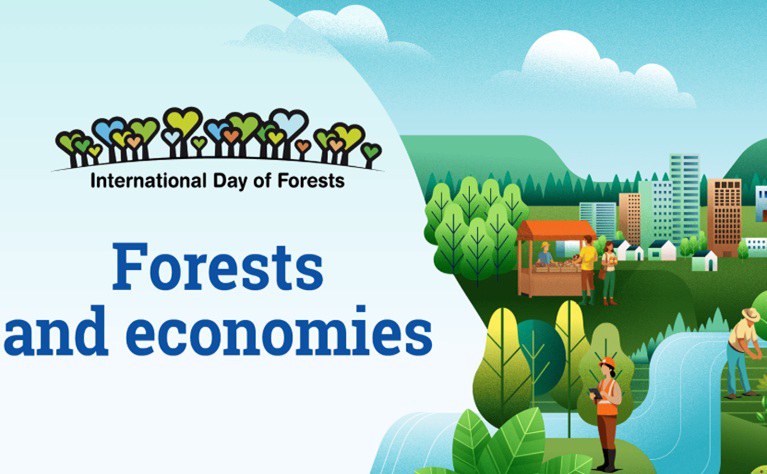
International Day of Forests 2026
The International Day of Forests is celebrated every year on March 21 and represents an important opportunity to reflect on the vital role forests play for our planet. Established in 2012 by the United Nations General Assembly, the Day aims to highlight the essential contribution forests make—not only in providing timber and non-wood forest products (such as berries, mushrooms, resins, and more), but also in delivering key ecosystem services, including erosion control, biodiversity conservation, climate regulation, and supporting the livelihoods of hundreds of millions of people.
The theme for the 2026 International Day of Forests is “Forests and Economies.” Forests support livelihoods, create jobs, reduce poverty, and strengthen food systems for billions of people around the world.
- https://www.isprambiente.gov.it/en/news/international-day-of-forests-2026
- International Day of Forests 2026
- 2026-03-21T00:00:00+01:00
- 2026-03-21T23:59:59+01:00
- The International Day of Forests is celebrated every year on March 21 and represents an important opportunity to reflect on the vital role forests play for our planet. Established in 2012 by the United Nations General Assembly , the Day aims to highlight the essential contribution forests make—not only in providing timber and non-wood forest products (such as berries, mushrooms, resins, and more), but also in delivering key ecosystem services, including erosion control, biodiversity conservation, climate regulation, and supporting the livelihoods of hundreds of millions of people. The theme for the 2026 International Day of Forests is “Forests and Economies.” Forests support livelihoods, create jobs, reduce poverty, and strengthen food systems for billions of people around the world.
- What evidence
- When Mar 21, 2026 (Europe/Berlin / UTC100)
-
Add event to calendar
 iCal
iCal
For many rural and forest-dependent communities, forests represent a primary source of income, food, energy, and resilience, especially during periods of economic or environmental stress.
Forests play a central role in the global carbon cycle, representing the biome with the highest carbon density (ranging from a few dozen to several hundred tonnes per hectare). Covering 3.9 billion hectares—about 30% of the Earth’s land surface—they are the most widespread terrestrial ecosystem on the planet. It is estimated that global forests store more than 1,100 billion tonnes of carbon across different pools: living biomass, dead organic matter, and soil.
These ecosystems continuously exchange vast amounts of carbon with the atmosphere: they absorb it through photosynthesis and release it through plant and soil respiration or as a result of natural and human-induced disturbances, such as wildfires, extreme weather events, pest and disease outbreaks, grazing, and forestry harvesting.
The indicator “Contribution of National Forests to the Global Carbon Cycle” in the Environmental Indicators Database of ISPRA analyzes two key parameters:
-
Carbon Stock: the total amount of carbon stored in national forest pools.
-
Carbon Sink (Stock Change): the net balance between carbon sequestered and carbon released (emissions) as a result of harvesting, natural mortality, or wildfires.
Both are fundamental indicators for assessing the health, productivity, and resilience of forest resources, while also providing a measure of the level of conservation and sustainability of forest management.
Finally, they define the strategic contribution of Italian forests to greenhouse gas mitigation and are crucial for achieving the emission reduction targets undertaken by Italy under the Paris Agreement and the United Nations Framework Convention on Climate Change (UNFCCC).