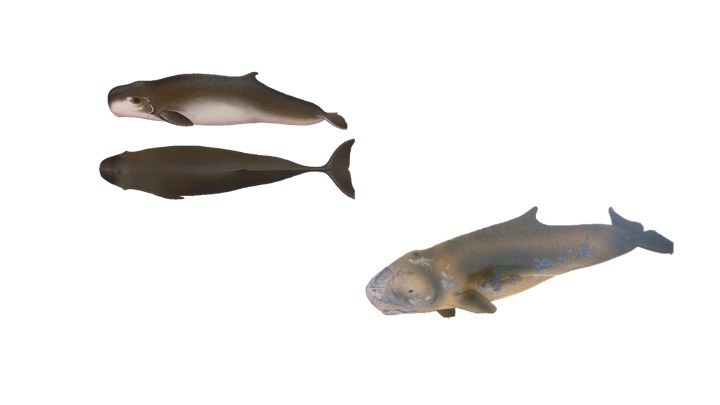
Invisible to the eye, but not to science: the pygmy sperm whale leaves its mark in the Mediterranean
Revealed by traces of DNA suspended in water
A discovery from the European project LIFE-CONCEPTU MARIS, led by ISPRA
New technologies are revolutionizing marine biology; an unexpected discovery is reshaping our understanding of biodiversity in the Mediterranean Sea. The pygmy sperm whale, or Blainville’s dwarf sperm whale (Kogia breviceps), previously believed to be absent from these waters, has been identified thanks to the analysis of environmental DNA (eDNA)—the collection of genetic traces that organisms leave behind in their environment.
No direct sightings, no underwater footage: the presence of this elusive cetacean has emerged through genetic traces released into the marine environment and collected in simple water samples. This innovative technique opens new perspectives for studying and monitoring hard-to-observe species and confirms the potential of “molecular investigation” as a key tool for exploring still poorly known ecosystems and updating species distribution in the Mediterranean.
The surprising discovery was made by researchers from the University of Milano-Bicocca, in collaboration with ISPRA, the Stazione Zoologica Anton Dohrn, and the University of Valencia. They worked within the European project LIFE-CONCEPTU MARIS, led by ISPRA and recently concluded, whose goal was to monitor cetaceans and sea turtles in the Mediterranean using commercial ferries as platforms for data and sample collection.
Profile of an elusive cetacean
The pygmy sperm whale reaches about 3–3.5 meters in length, inhabits tropical and warm temperate seas, and feeds mainly on squid, which it locates using sophisticated biosonar. Extremely rare to observe in the open sea, it is likely more widespread than it appears: it simply spends most of its life far from the coast and out of human sight.
To detect it, researchers collected seawater samples from commercial ferries in transit. In total, 12 liters of water were collected at each of the 393 sampling points across the central-western Mediterranean.
The water, immediately filtered on board, allowed scientists to capture all suspended biological material containing DNA fragments. In the laboratory, using advanced sequencing techniques, the surprising discovery was made: pygmy sperm whale DNA was found in 10 different samples, corresponding to at least 5 independent presence events. These traces were distributed across a vast area stretching from the Tyrrhenian Sea to the Strait of Gibraltar.
Its defense strategy
Paradoxically, the DNA of the pygmy sperm whale was found more easily than that of other rare cetaceans that are sighted more frequently. This is due to its extraordinary defense strategy. When threatened, cetaceans of the genus Kogia release a brownish-red fluid from an internal “ink sac,” similar to that of squids. This fluid creates a large cloud that hides them from predators such as orcas or sharks. Released in large quantities (up to 11 liters at a time), the fluid is extremely rich in DNA. As a result, the same mechanism that makes the pygmy sperm whale invisible to predators makes it highly detectable through molecular analysis.
Where and for how long it has existed
The wide geographic and temporal distribution of detections, together with the presence of different genetic profiles, suggests that these are not just occasional individuals arriving from the Atlantic. It is far more likely that a stable, established population of pygmy sperm whales exists in the Mediterranean.
An even more fascinating hypothesis is that this Mediterranean population may be a “relict”—a subpopulation that has remained isolated for a long time. This is suggested by the discovery of a unique genetic profile, different from those of Atlantic individuals near Gibraltar, which could indicate a long evolutionary history within the basin.
This scientific discovery has an important practical consequence: it supports the request to officially include the pygmy sperm whale in international protection lists for the Mediterranean, such as the ACCOBAMS, in order to ensure its conservation.
The discovery has recently been published in Mammal Review, a leading quarterly journal covering applied ecology, conservation, and mammal management, as well as animal behavior and population dynamics, confirming the robustness and scientific relevance of the findings.

Foto: Robin Baird (Cascadia Research)