
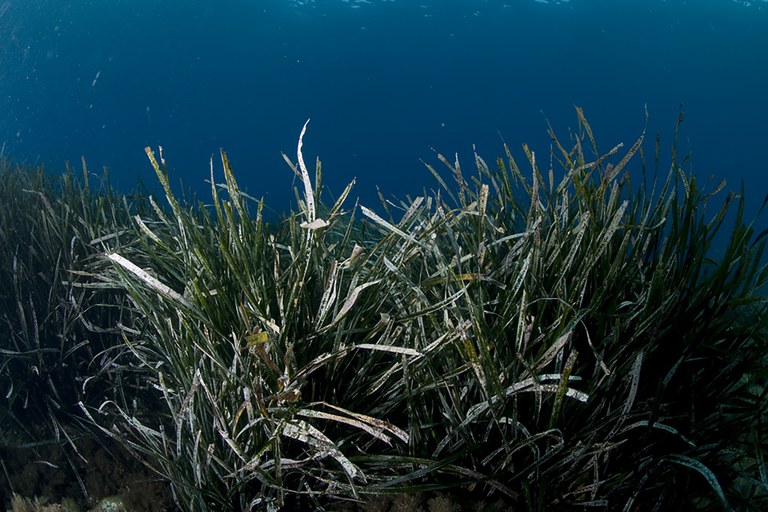
LIFE Sea Forest: Posidonia oceanica meadows as blue carbon reservoirs in the Mediterranean
Restored over 100 small meadow areas, planted more than 1,300 cuttings
The LIFE SeaForest project – Posidonia meadows as carbon sinks of the Mediterranean, launched in 2018 and concluding in December, and presented today at the Rome headquarters of ISPRA, aims to enhance the important role of Posidonia oceanica meadows as “Blue Carbon reservoirs” of the Mediterranean Sea. The project works to increase their capacity to capture and store CO₂, while countering erosion and degradation.
The project has made it possible to achieve significant results, including the development of a methodological protocol for quantifying the carbon dioxide sequestered by Posidonia oceanica, which represents a key step toward the future economic valorization of the ecosystem service of CO₂ absorption and immobilization
To promote the sustainable management of marine ecosystems, SeaForest LIFE developed innovative solutions and replicable technical and management tools to integrate the value of Blue Carbon into climate-mitigation policies and coastal planning. This represents a concrete contribution to the European goals of climate neutrality and biodiversity conservation, enhancing the ability of this ecosystem to remove significant amounts of carbon dioxide from the atmosphere.
Among the most significant results, the project introduced an advanced system of sustainable moorings in the three National Parks, drastically reducing anchoring damage to Posidonia meadows.
Specifically, 63 mooring points were installed in the Asinara Island MPA, 26 in the Santa Maria di Castellabate MPA, as well as 60 refurbished moorings and 107 new moorings in the La Maddalena Archipelago National Park.
To support management activities, a dedicated app was developed for bookings, carrying-capacity monitoring, reporting, and updates on habitat status, making use of the areas more sustainable, transparent, and efficient.
Concerning habitat restoration—an area in which ISPRA was particularly involved—over 100 small areas of Posidonia oceanica meadows damaged by recreational boat anchoring were restored using seeds, cuttings, and washed-up sprouts. More than 1,300 cuttings of Posidonia oceanica naturally uprooted by storms were planted. Results are very encouraging, with survival rates of up to about 80% for the transplanted cuttings.
ISPRA also developed an Operational Protocol detailing procedures for restoration interventions aimed at reconnecting fragmented Posidonia oceanica meadows.
LIFE SeaForest estimated the CO₂ emissions avoided thanks to the reduction of meadow degradation caused by unregulated anchoring. Estimates indicate that project activities could prevent more than 5,365 tonnes of CO₂ over ten years, almost all in the La Maddalena area. The SeaForest LIFE project also led to the creation of a “carbon market” where companies seeking to reduce their emissions and wishing to purchase carbon credits can offset their footprint—helping not only to mitigate climate change, but also to directly finance conservation and restoration efforts for Posidonia meadows, thereby contributing concretely to achieving the global sustainable-development goals set by the United Nations.
Since its inception in 2018, ISPRA has actively participated in the LIFE SeaForest project as a partner alongside CNR, the University of Tuscia, Carbonsink, the La Maddalena Archipelago National Park, the Asinara National Park, and the Cilento, Vallo di Diano and Alburni National Park, in addition to the lead partner D.R.E.Am. Italia.
LIFE SeaForest now stands as a replicable model across the Mediterranean basin, aligned with European objectives for climate neutrality, biodiversity protection, and sustainable development.