
MER Project – Coastal Mapping: Exploring the Submerged Wonders of the Baia Archaeological Park
Just off the coast of Naples, beneath the tranquil waters of Baiae, lies one of the Mediterranean's most fascinating underwater treasures: the Baiae Underwater Archaeological Park. This unique site offers an extraordinary glimpse into ancient Roman civilization, now lying between 5 and 13 meters below sea level.
Once a luxurious resort for the Roman aristocracy, Baiae was renowned for its opulence and thermal baths. Over the centuries, volcanic activity and coastal subsidence gradually caused part of the city to sink beneath the sea. Today, the underwater park preserves the remains of Lacus Baianus and Portus Julius, two important ports of the Roman Empire. To the west, the port of Cape Misenum served as a base for the Roman imperial fleet.
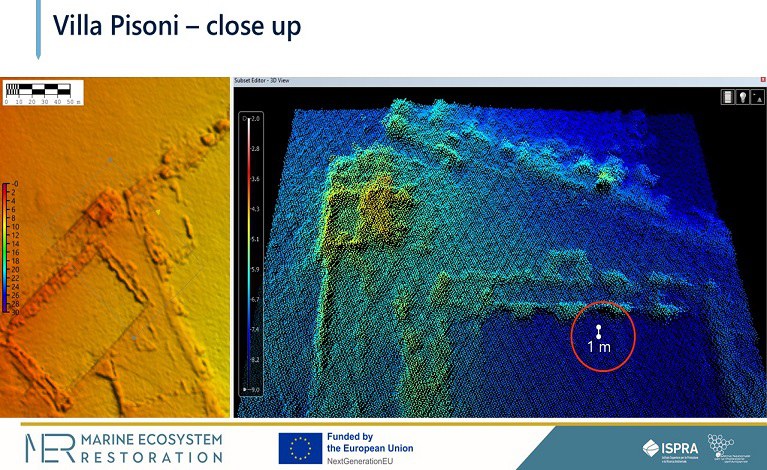
On June 5, 2025, a high-resolution bathymetric LiDAR aerial survey was conducted in the Campania region. It mapped the seabed with a resolution of 1 m² or better, revealing the layout and structures of the ancient submerged city with remarkable clarity. Among the identified features were the sea walls, the entrance to Portus Baianus, the Villa dei Pisoni, the Secca Fumosa, and Portus Julius.
The primary objective of the survey, conducted as part of the MER (Marine Ecosystem Restoration) project, was to map seagrass habitats. However, the survey also produced detailed images of the Submerged Archaeological Park of Baia, demonstrating the effectiveness of using advanced LiDAR bathymetry for multidisciplinary applications. In this area, ancient ruins and seagrass meadows coexist side by side, highlighting the potential for integrated conservation strategies capable of protecting both cultural heritage and natural ecosystems.