On the wings of conservation: satellite monitoring of Isidoro for the future of the Golden Eagle
Within the framework of the LIFE Abilas project on the reintroduction of the Bonelli’s Eagle in Sardinia, ISPRA is conducting research on the ecological interaction between the Golden Eagle and the Bonelli’s Eagle in the Mediterranean. The aim is to identify possible differences in dispersal strategies, spatial distribution, and potential overlap areas between the two species, in order to develop the most effective conservation strategies.
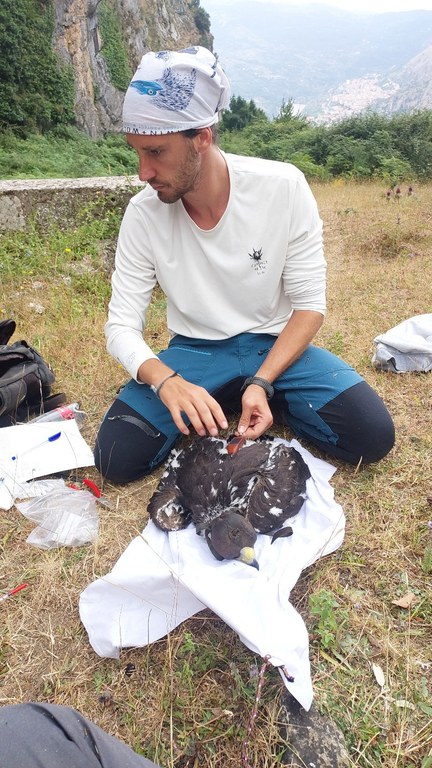
In Sicily, where a thriving population of Bonelli’s Eagle is present, on July 15, 2025, the first Golden Eagle chick, Isidoro, was tagged (equipped with a GSM/GPS satellite transmitter) at a historic site within the Parco regionale dei Nebrodi. Continuously monitored thanks to a webcam providing real-time images, on August 18, 2025, at around 1:00 PM, it left the nest.
After fledging, a temporary phase of dependence on the parents followed. During this period—typically lasting between two and three months (with considerable variability)—the young bird had the opportunity, with constant parental support, to learn the skills necessary for survival, mastering flight and hunting.
When it finally feels ready, the young eagle enters its dispersal phase, initially moving away from the natal area, alternating between exploratory movements and temporary territorial stops, as well as returns to its birthplace, until the definitive departure in search of a new territory to occupy.
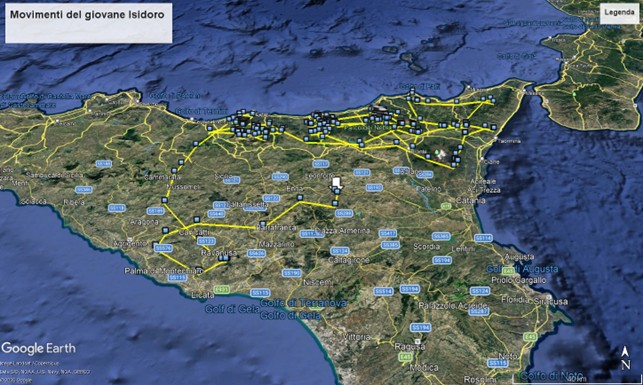
On January 21, Isidoro made its first significant movement, traveling several tens of kilometers before returning to its natal site after four days. At the end of February, another notable movement occurred, also involving the Mount Etna, followed once again by a return after a few days. Finally, on March 7, it began its natural dispersal.
In recent weeks, the young eagle has crossed numerous territories of other Golden Eagles, visiting areas such as the Parco dell’Etna and the Madonie, covering nearly 2,400 kilometers.
The dispersal phase represents the most critical period in the species’ life cycle due to high mortality rates. Successfully overcoming this stage is crucial for reaching reproductive age. It is therefore desirable that the individual manages to settle in a suitable territory, thus contributing to the consolidation of the population and the conservation of the species, which in Sicily—compared to other parts of its range—remains relatively rare.