Pollen Monitoring in Italy: Insights from the CAMS NCP Survey
Every spring, millions of people in Italy have to deal with allergies and respiratory disorders related to the presence of pollen in the air. But how well known and adequate are the tools currently available? And which information is truly useful for those conducting research, those involved in public health prevention, or those who manage allergenic risk on a daily basis?
To answer these questions, a national survey targeting the community of pollen data users was carried out within the framework of the CAMS National Collaboration Programme Italy—an initiative launched by ISPRA in collaboration with the European Centre for Medium-Range Weather Forecasts (ECMWF)
The survey, also promoted through ISPRA’s communication channels, collected 75 responses, with a strong prevalence of specialist profiles: about 60% of respondents are researchers and environmental professionals. Alongside them, healthcare professionals and citizens interested in the prevention and management of allergic symptoms also took part.
The results provide an overview of priorities and needs for developing increasingly integrated services capable of combining ground-based monitoring network data with forecast products from the Copernicus Atmosphere Monitoring Service (CAMS).
User profile: between research and prevention
Professional use (63%): The majority of respondents use pollen data for research activities, environmental monitoring, or technical consultancy.
Health management (around 20%): A significant share consults pollen bulletins for clinical prevention and the daily management of allergic symptoms.
The “most closely monitored” pollens
In line with the characteristics of Mediterranean flora, users’ botanical interest is concentrated on specific allergenic families. The preferences expressed indicate a clear hierarchy:
-
Poaceae (grasses): more than 45 preferences
-
Oleaceae: more than 35 preferences
-
Other relevant families: Cupressaceae, Betulaceae and Urticaceae
POLLnet and Copernicus
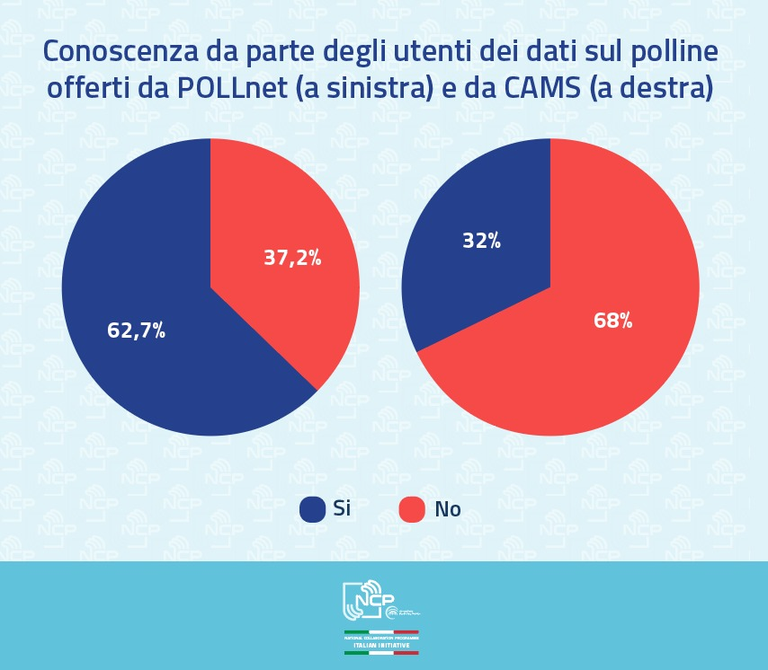
The analysis highlights a crucial finding regarding the perception of information sources. There is a clear gap in awareness between national measurement networks and forecast data provided by European models:
-
POLLnet: The institutional monitoring network is known by 63% of participants.
-
CAMS (Copernicus Atmosphere Monitoring Service): Only 32% of respondents are familiar with the tools provided by the European Copernicus programme.
This gap highlights the need for greater dissemination of the potential of Copernicus data, which integrate ground observations with continental-scale forecasting models.
Priorities for the future: integration and resolution
What is currently missing from existing services? Participants identified three key pillars for improving pollen monitoring:
-
Spatial resolution: A demand for forecasting models with greater spatial detail across the national territory.
-
Integration: Greater combination and harmonisation of atmospheric data, territorial observations, and transport models.
-
Accessibility: Development of user-friendly interfaces capable of translating complex data into information that can also be easily used by non-specialist users.
The final objective, shared almost unanimously, is the creation of new communication tools capable of generating tangible added value in the management of allergenic risk. The CAMS National Collaboration Programme Italy aims precisely at this goal, producing by the end of next year a prototype tool designed for citizens, technicians, doctors, researchers and health institutions, helping to optimise allergenic risk management at the national level.
Beyond the pollen theme, the CAMS National Collaboration Programme Italy also works to strengthen national air quality modelling systems, adding information on Saharan dust concentrations over Italy, and promoting training and information activities.
The broad partnership, coordinated by ISPRA, includes ENEA, CNR-ISAC, the University of Tor Vergata, the Italian Copernicus Academy Consortium, and 8 of the 21 regional environmental agencies:
ARPAe Emilia-Romagna, ARPA Lombardia, ARPA Campania, ARPA Liguria, ARPA Piemonte, ARPA Veneto, ARPA Umbria, and ARPA Valle d’Aosta.
The full survey results are available on the official portal: Survey results CAMS NCP Italia