
Rigid coastal defense works, a step forward in knowledge: the ISPRA geodatabase has been published
Italy today has almost one fifth of its coastline affected by the presence of rigid coastal defense works: as of 2020, this amounted to more than 1,500 km of coastline, equal to 18%, representing a 27% increase compared to 2000 data—over 200 km of coastline. Calabria, more than other regions, has seen the length of coastline affected by these structures grow by 66%. From 2020 to today, following the same trend, an additional roughly 50 km would have been added.
Climate change has led to an increase in the frequency and intensity of extreme weather events, such as Mediterranean cyclones and storm surges; sea-level rise and alterations in wind and current regimes amplify wave energy, accelerating coastal erosion processes and increasing the vulnerability of already fragile coastlines. In this context, events such as Cyclone Harry, which recently struck the coasts of Sicily, Calabria, and Sardinia, are no longer isolated incidents but signs of a structural trend that adds to the effects of certain human activities and calls for increasingly integrated, evidence-based coastal adaptation and management strategies.
Events like these have refocused attention on the knowledge and tools that can be applied to prevent the recurrence of phenomena such as those that occurred in recent days, starting with the mapping of interventions already carried out—especially “rigid” defense works, such as breakwaters—which continue to expand despite national guidelines emphasizing that these are solutions capable of limiting impacts at specific sites but which, at the same time, hinder natural beach nourishment along entire stretches of coastline by blocking sediment transport along the shore.
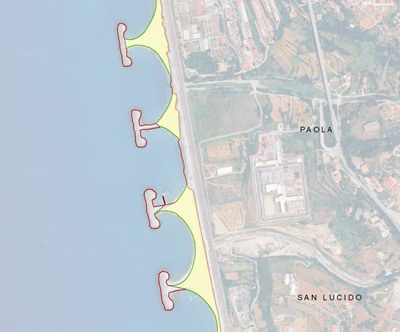
Over recent decades, nearly 11,000 rigid coastal defense structures have been installed along the coastline, interacting in different ways with the surrounding natural areas. For example, in Liguria the installation of groynes is very common—breakwaters perpendicular to the coast that are able to trap sediment dynamics. Along the Adriatic regions, most beaches are affected by the presence of various types of offshore breakwaters, detached from the shoreline, which can reduce wave action and therefore the impact of storm surges. Rigid structures often also take on particular forms for specific functions, such as the system of large “T-shaped” groynes along the Calabrian Tyrrhenian coast.
Knowing and being able to integrate into future studies the rigid structures that have been built and the stretches of coastline affected by these interventions has now become a key element for implementing more effective tools, such as coordinated planning and local actions, typically beach nourishment.
ISPRA has published and made freely available, in the form of a geoDB, data that identify and characterize the stretches of the Italian coastline affected by the presence of rigid coastal defense works installed across the country—those stretches influenced by structures such as breakwaters, groynes, concrete seawalls, or shore-parallel revetments. The publication of this geoDB complements that of the ISPRA “Coastal Configuration” geoDBs, which examine the entire national coastal setting, including high-resolution mapping of all rigid coastal defense works along the Italian shoreline. In line with the European INSPIRE Directive, these datasets will soon be updated thanks to the results of the PNRR-MER (Marine Ecosystem Restoration) project.
The GeoDB represents the Italian reference framework for the definition of the coastline, providing an additional valuable element for coastal monitoring, planning, and design.
LINK to the GEODB: https://tinyurl.com/4nybzxpf