The Guardian of the Coastal Dunes: The Conservation of the Kentish Plover Tells the Story of the Health of Mediterranean Coasts
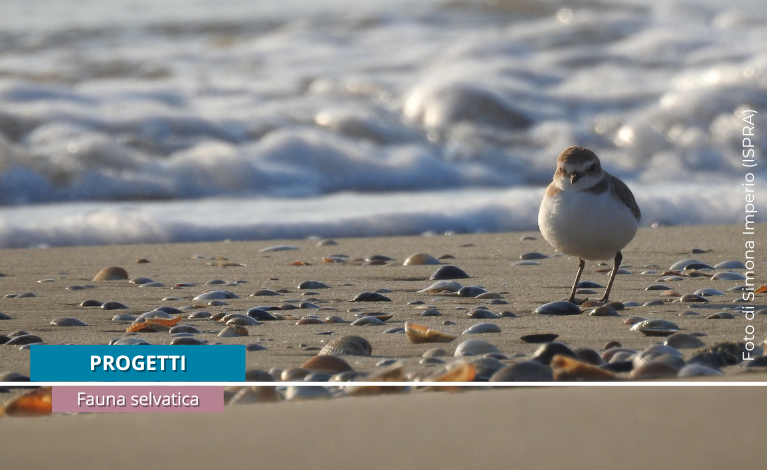
In order to stop the rapid decline of the Kentish plover (Charadrius alexandrinus), the Life ALEXANDRO project has just been launched. It is co-funded by the European Union’s LIFE Programme and aims to protect the species while promoting a sustainable model for coastal management. Classified as “Endangered” on the IUCN Red List of Italian vertebrates, the Kentish plover has declined from more than 1,300 estimated breeding pairs in 2004 to about 500 in 2023, mainly due to tourism pressure and the loss of dune habitats.
The project involves 10 Italian regions and the Croatian region of Zadar, covering a total of about 400 km of coastline. Planned actions include nest protection, monitoring, habitat restoration, and dialogue with public authorities and beach tourism operators. ISPRA will play a central role: it will coordinate concrete conservation actions, develop research activities to identify the most suitable nesting areas at the national scale, and prepare Guidelines for the protection of the species.
The project also fits within the framework of the international commitments undertaken by Italy under the Agreement on the Conservation of African-Eurasian Migratory Waterbirds (AEWA), strengthening conservation actions dedicated to migratory waterbird species and their habitats along the Afro-Eurasian flyways.
Life ALEXANDRO therefore represents a concrete step toward safeguarding the natural beaches of the central Mediterranean, demonstrating that biodiversity conservation and sustainable tourism can—and must—go hand in hand.
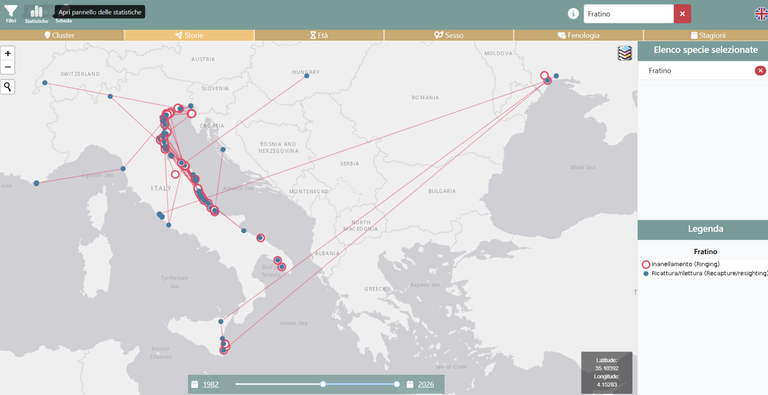
Recaptures and Sightings of Colour-Ringed Kentish Plovers in Italy. Imagine from atlanteinanellamento.isprambiente.it
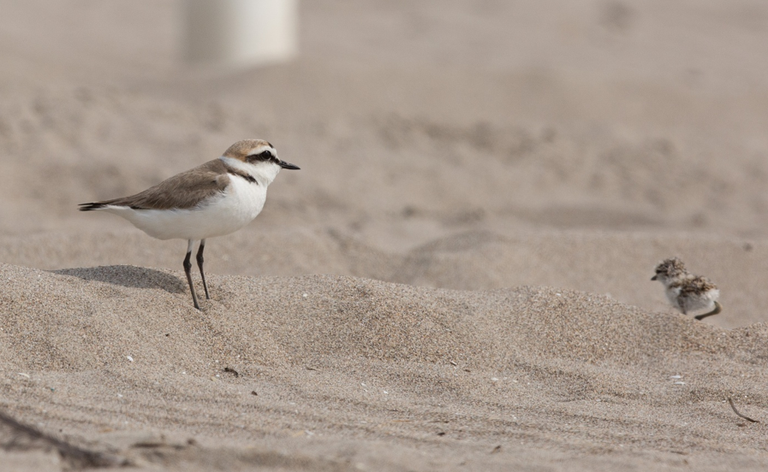
Photo: Marco Basso