Wildfires on the Rise in 2025: More Investment in Prevention Needed
ISPRA Updates Its Webpage on the Impacts of Large Wildfires on Ecosystems
Monitoring activities carried out by ISPRA during 2025 show an increase in wildfire occurrence compared with the previous year. The total area affected reached 965 km² (equivalent to the size of the Province of Pistoia), a figure that nearly doubles the estimates recorded in 2024. Historical data archived by the European Forest Fire Information System (EFFIS) place 2025 among the years with the highest wildfire severity, surpassed only by the peaks recorded in 2007, 2017, 2021, and 2023.
These findings emerge from ISPRA’s monitoring programme on the impacts of large wildfires, a system that provides robust and up-to-date data each year to support national and regional authorities. The analyses, based on high-resolution satellite observations, ensure methodological consistency and statistical representativeness. Any discrepancies with other datasets are limited and do not affect the overall interpretation of the phenomenon.
A particularly significant finding concerns the incidence of wildfires within the protected areas network, where more than 30% of the total burned area was concentrated and as much as 38% of the forest ecosystems affected by fire nationwide were located.
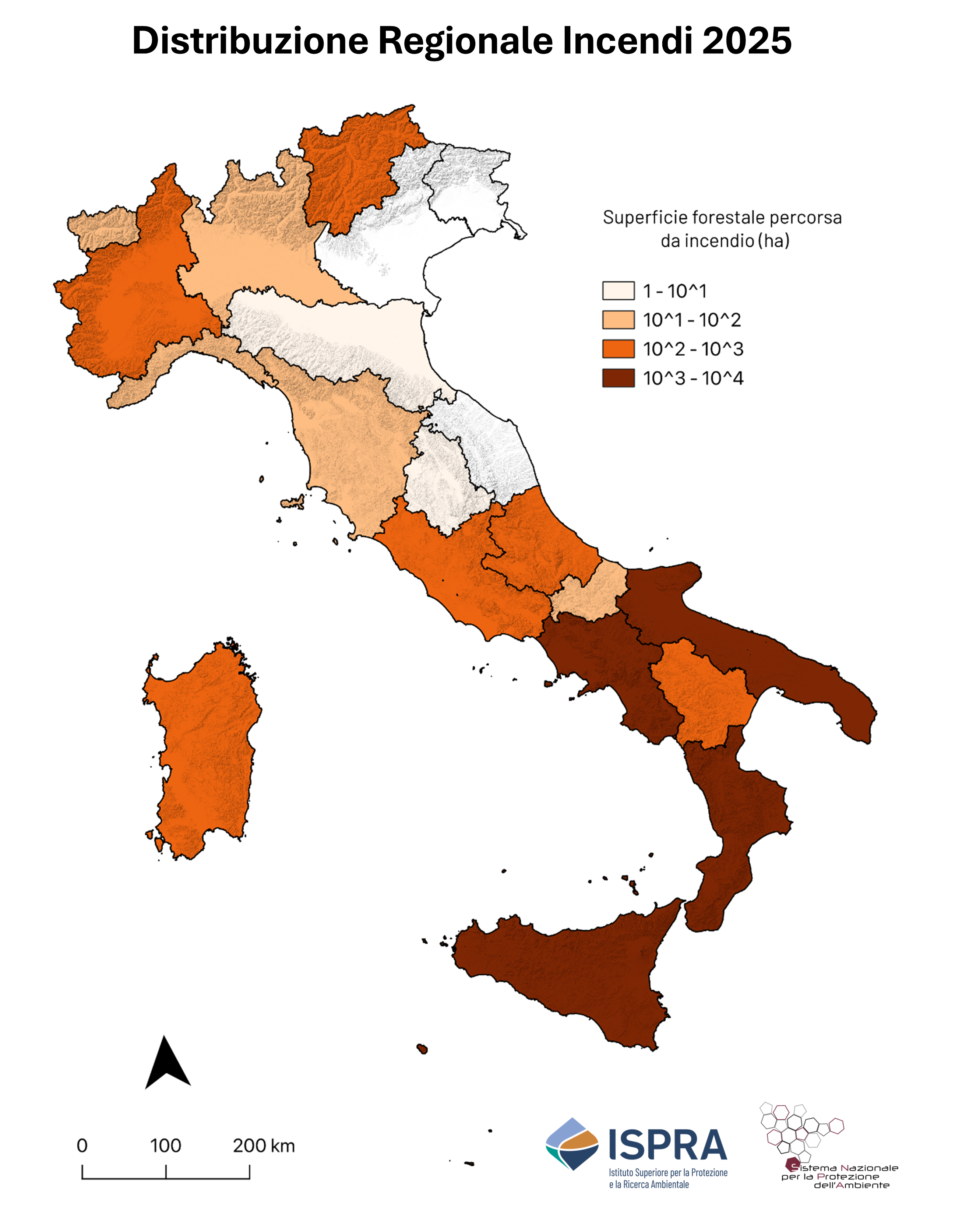
Considering the entire national territory, 48% of wildfire events in 2025 affected forest ecosystems. In terms of area, approximately 123 km² of forest land (equivalent to the size of the Municipality of Ancona) was affected by fire, distributed as follows:
- approximately 57 km² of evergreen broadleaf forests (mainly holm oak forests, cork oak forests, and tall Mediterranean maquis);
- approximately 36 km² of deciduous broadleaf forests (oak woods, chestnut forests, and beech forests);
- more than 24 km² of evergreen coniferous forests (natural forests and conifer plantations);
- the remaining 5.79 km² consisting of mixed forest systems.
At the territorial level, the historical trend confirming Southern Italy and the major islands as the most affected areas continues. In particular, Sicily, Calabria, and Campania were the regions most severely impacted, accounting for 71% of the total national forest area affected by wildfires. An increasing trend in the annual extent of burned forest areas is also observed in the regions of Basilicata, Calabria, and Apulia (Puglia).
Preliminary Data for 2026
From 1 January to 9 June 2026, a total area of approximately 60 km² (equivalent to the size of Lake Bracciano, near Rome) was affected by wildfires, of which nearly 20 km² consisted of forest cover. Currently, around 28% of the forest areas affected by fire are located in the Tuscany region. Calabria is the second most affected region, accounting for approximately 23% of the total.
Maria Alessandra Gallone, President of ISPRA and the National System for Environmental Protection (SNPA):
"Forests are among the most valuable assets of our country: they safeguard biodiversity, absorb carbon, protect soils, and contribute to the well-being of communities. The 2025 data remind us that wildfires are not merely an environmental emergency, but a challenge that affects territorial safety, the economy, and people's quality of life. This is why greater investment in prevention, knowledge, and rapid response capacity is essential. No institution can address this challenge alone: a broad alliance is needed among the State, Regions, local authorities, the scientific community, the civil protection system, the agricultural sector, and citizens. ISPRA and the National System for Environmental Protection provide data, monitoring activities, and scientific expertise to support effective decision-making and foster an increasingly widespread culture of prevention. Protecting our forests means protecting the future of the country."
Roberto Inghilesi, Head of ISPRA’s Environmental Monitoring Operations Centre:
"The Institute’s activities in satellite monitoring and in the study of wildfire impacts on natural ecosystems provide a solid scientific basis for assessing current trends and the potential consequences associated with climate change. Understanding how forest ecosystems respond to wildfire events, and the timescales involved, is essential for effectively guiding management, restoration, and prevention strategies in a context of increasing climate pressure."
All data can be consulted and downloaded from the ISPRA webpage “Ecosystems and Wildfires in Italy”.