
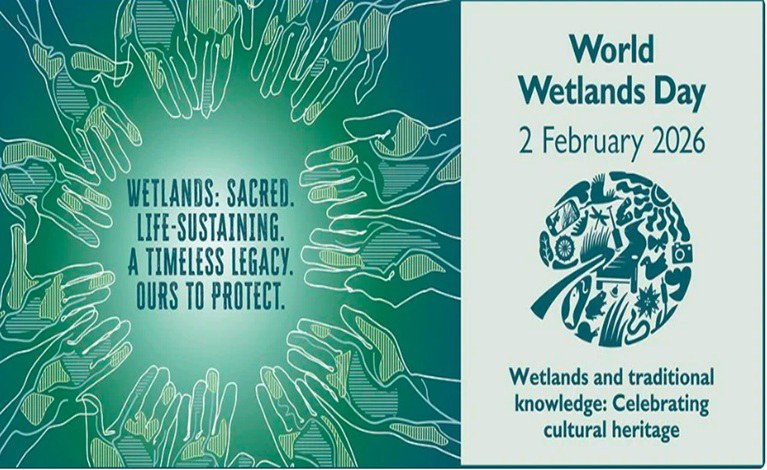
World Wetlands Day
World Wetlands Day, celebrated on 2 February, marks the signing in 1971 of the Ramsar Convention on Wetlands of International Importance and aims to raise global awareness of the crucial importance of wetlands for people and for our planet.
The Ramsar Convention defines wetlands as “areas of marsh, fen, peatland or water, whether natural or artificial, permanent or temporary, with water that is static or flowing, fresh, brackish or salt, including areas of marine water the depth of which at low tide does not exceed six metres” The Convention is the only international environmental treaty specifically focused on these ecosystems which, in addition to hosting and conserving a rich biological diversity of plants, birds, mammals, reptiles, amphibians, fish and invertebrates, provide substantial water and food resources and play a fundamental role in mitigating climate change.
- https://www.isprambiente.gov.it/en/news/world-wetlands-day
- World Wetlands Day
- 2026-02-02T00:00:00+01:00
- 2026-02-02T23:59:59+01:00
- World Wetlands Day , celebrated on 2 February, marks the signing in 1971 of the Ramsar Convention on Wetlands of International Importance and aims to raise global awareness of the crucial importance of wetlands for people and for our planet. The Ramsar Convention defines wetlands as “areas of marsh, fen, peatland or water, whether natural or artificial, permanent or temporary, with water that is static or flowing, fresh, brackish or salt, including areas of marine water the depth of which at low tide does not exceed six metres” The Convention is the only international environmental treaty specifically focused on these ecosystems which, in addition to hosting and conserving a rich biological diversity of plants, birds, mammals, reptiles, amphibians, fish and invertebrates, provide substantial water and food resources and play a fundamental role in mitigating climate change.
- When Feb 02, 2026 (Europe/Berlin / UTC100)
-
Add event to calendar
 iCal
iCal
This year’s theme is “Wetlands and Traditional Knowledge: Celebrating Cultural Heritage.” World Wetlands Day 2026 aims to highlight the timeless role of traditional knowledge in supporting wetland ecosystems and preserving cultural identity.
To date, the wetlands of international importance listed in the official Ramsar Convention register for Italy number 61, distributed across 15 regions, covering a total area of 78,385 hectares. The table presents the complete list of sites, in chronological order of designation from 1976 to 2021, and also includes an additional five sites identified by Ministerial Decrees in 2011 and 2013 (in Sicily and Tuscany), which are currently awaiting official designation by the Convention Secretariat.
Among the nine criteria used to assess the importance of wetlands, the Ramsar Convention identifies two that are specifically based on waterbirds: sites that regularly support at least 20,000 individuals (Criterion 5) or at least 1% of a species, subspecies, or population (Criterion 6) are considered to be of international importance.
The censuses of wintering waterbirds (International Waterbird Census) in Italy are coordinated by ISPRA.
In Italy, the censuses are taking place from 6 to 25 January across more than 2,000 wetlands. The project relies on a network of over 500 expert surveyors and around 1,500 collaborators, distributed throughout the country. With more than 30 years of continuous activity across the entire national territory, the IWC censuses are among the longest-running Italian research projects, and certainly the leading one in terms of geographical coverage and regularity.
The year 2026 marks the 60th anniversary of the IWC censuses.
The census of wintering waterbirds celebrates its first 60 years.
On February 2, a conference organized by the Ministry of Agriculture, Food and Agriculture (MASE), the Food and Agriculture Organization (FAO), ISPRA, the Lazio Region, and the Nature Reserve will be held at the FAO and the Nazzano Tevere-Farfa Regional Nature Reserve. The conference will be attended by Undersecretary of State Claudio Barbaro, FAO Deputy Director-General Beth Bechdol, and Ramsar Convention Secretary Musonda Mumba. The conference will bring together diplomatic representatives, international organizations, management bodies, local authorities, academia, civil society, and the private sector.