The Hidden City
Jun 10, 2026ISPRA Presents the Updated Map of Rome’s Underground Cavities
The 2026 Density Map of Rome’s Underground Cavities highlights that more than 100 km² of the Eternal City’s territory is affected by the presence of underground voids, while nearly 61 km² fall within areas characterized by a high density of cavities. The highest concentrations are found in Municipalities I, II, IV, V, and VIII, corresponding to areas historically affected by the extraction of pozzolana and tuff, as well as by the presence of extensive catacomb systems. In contrast, the northwestern and western sectors of the urban area show a lower concentration of cavities, reflecting the different lithological characteristics of the outcropping rocks and the lower intensity of past quarrying activities.
These findings emerge from the Update of the Map of Rome’s Underground Cavities 2026, prepared by ISPRA’s Department for the Geological Survey of Italy in collaboration with the Institute of Environmental Geology and Geoengineering (CNR-IGAG) and the University of Tuscia. The map was presented today at the Appia Antica Regional Park.
The map is conceived as a dynamic and continuously evolving tool, subject to periodic revisions through the incorporation of new data, additional surveys, and the progressive improvement of positional accuracy. This process also benefits from advances in surveying and georeferencing technologies.
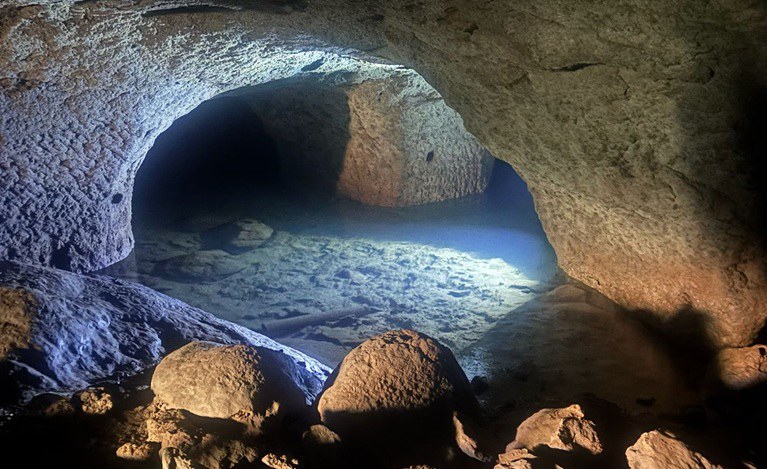
Overall, the project compiled approximately 5,600 point records (indicating the presence of cavities whose full extent is unknown) and 1,600 linear and polygonal records (representing the development of underground tunnels or the general footprint and, where available, the precise layout of cavities). These data refer to various types of underground structures, including quarries, catacombs, hypogea, hydraulic tunnels, and underground infrastructure, covering an area of approximately 350 km² of Rome’s urban territory characterized by the presence of subterranean systems.
The study updates the map originally produced by ISPRA in 2017, in collaboration with Roma Capitale and the speleological associations Roma Sotterranea and Sotterranei di Roma. The dataset is based on the integration of bibliographic sources, historical cartographic archives, archaeological maps, and direct field investigations.
Why Rome?
Rome is underlain by a complex network of human-made underground cavities, whose full extent remains only partially known. These cavities are the result of more than two thousand years of excavation and subsurface exploitation, carried out with varying intensity from the Roman era through the mid-twentieth century.
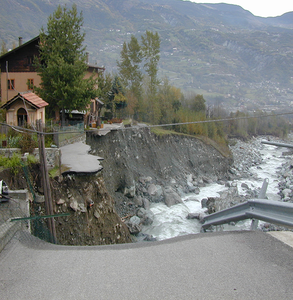
The presence of these underground voids constitutes one of the main triggering factors for ground collapses and anthropogenic sinkholes that affect the urban environment of Rome, making their identification, mapping, and monitoring essential for urban planning and risk management.
Maria Alessandra Gallone, President of ISPRA and the National System for Environmental Protection (SNPA), stated:
“Understanding the subsurface of the Capital means understanding a fundamental part of its identity, its history, and its future. Beneath Rome’s streets, buildings, and monuments lies an extraordinary heritage, shaped by centuries of historical stratification and urban development. A thorough knowledge of the underground environment is not merely a scientific and technical necessity; it is also an essential tool for enhancing the city’s capacity to plan its future development, prevent potential hazards, and promote resources that are often invisible yet possess immense cultural, historical, and environmental value”.