
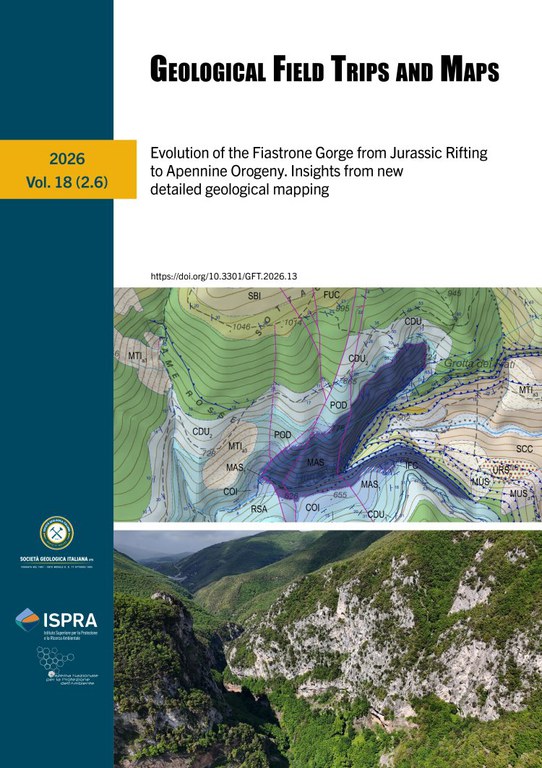
Evolution of the Fiastrone Gorge from Jurassic Rifting to Apennine Orogeny. Insights from new detailed geological mapping
A new 1:10,000-scale geological mapping of the Fiastrone Gorge (Northern Apennines), provides a revised interpretation of its Jurassic palaeogeographic and tectonic evolution. The Meso-Cenozoic evolution of the Umbria–Marche succession, exposed in the area, was controlled by the complex palaeogeography inherited from Early Jurassic rifting of the Western Tethys. At the eastern margin of the gorge, the Sibillini Mountains Thrust places the Calcare Massiccio over the Scaglia Cinerea, with intervening duplexes of Jurassic–Cretaceous pelagic units. Previous studies interpreted the area as a Jurassic structural high capped by a condensed pelagic succession, but new field data demonstrate that the contact between the Calcare Massiccio and the overlying Jurassic units is a complex unconformity, characterised by pervasive silicification of the Calcare Massiccio, with no evidence of any condensed succession. The upper Bajocian–lower Kimmeridgian Calcari Diasprigni represents the youngest unit burying the structural high, indicating a modest palaeorelief compared to other highs in the Umbria–Marche Domain. The Jurassic high displays a cusp-shaped geometry rather than a flattopped pelagic carbonate platform. Miocene normal faults displaced parts of the high prior to compression. Structural restoration suggests that the thrust may have reactivated a pre-existing Jurassic extensional fault, likely bounding a broader structural high to the east.