
AQuaBioS at Aquawest: The Sea Farm as a Model for Sustainable Aquaculture in the Western Mediterranean
On June 11 and 12, the historic buildings of the capital were illuminated in blue as they hosted two intensive days of discussions dedicated to the Blue Economy, jointly coordinated by the Italian and Maltese national groups of the WestMED Initiative. Now in its fourth edition, the event brought together national public institutions, researchers, and stakeholders from the production, logistics, and tourism sectors to discuss the Mediterranean and its central role in the economic, environmental, and social life of the countries bordering it.
In this context, the Interreg IFM 2021–2027 project AQuaBioS, which had already established contact with and attracted the interest of the international WestMED network in February, presented its objectives and the initial results achieved during its first two years of activity. The project shared with participants the vision developed by its cross-border partnership for promoting organic and sustainable aquaculture.
- https://www.isprambiente.gov.it/en/aquabios-at-aquawest-the-sea-farm
- AQuaBioS at Aquawest: The Sea Farm as a Model for Sustainable Aquaculture in the Western Mediterranean
- 2026-06-11T00:00:00+02:00
- 2026-06-12T23:59:59+02:00
- On June 11 and 12, the historic buildings of the capital were illuminated in blue as they hosted two intensive days of discussions dedicated to the Blue Economy, jointly coordinated by the Italian and Maltese national groups of the WestMED Initiative. Now in its fourth edition, the event brought together national public institutions, researchers, and stakeholders from the production, logistics, and tourism sectors to discuss the Mediterranean and its central role in the economic, environmental, and social life of the countries bordering it. In this context, the Interreg IFM 2021–2027 project AQuaBioS , which had already established contact with and attracted the interest of the international WestMED network in February, presented its objectives and the initial results achieved during its first two years of activity. The project shared with participants the vision developed by its cross-border partnership for promoting organic and sustainable aquaculture.
- When Jun 11, 2026 to Jun 12, 2026 (Europe/Berlin / UTC200)
- Where Rome
-
Add event to calendar
 iCal
iCal
An innovative model, the Sea Farm, based on diets composed of locally sourced phytoplankton and zooplankton, has the potential to reverse a dramatic trend: the depopulation of marine life, the degradation of coastal and marine ecosystems, and the crisis affecting the aquaculture sector, a productive activity deeply rooted in the many cultures that, “like frogs or ants around a pond,” overlook the Mediterranean.
The importance of the work carried out through the cooperation of the AQuaBioS partners, led by ISPRA as project coordinator, has received significant recognition in recent days with the project’s inclusion in AquaWest, the Aquaculture Technical Group of the WestMED Initiative. This achievement is of great importance not only for the dissemination of the project and its future developments, but also for strengthening a continuous exchange that places at its core the health and vitality of this body of water, which unites and connects so many lands. It promotes a living yet respectful relationship between human beings and the sea, fostering sustainable interaction and shared stewardship of the Mediterranean.
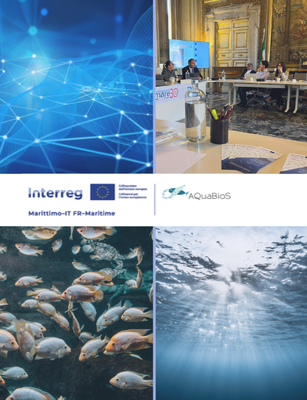
The network is expanding, ideas are multiplying, and exchanges of best practices are increasing. Here, the sea is no longer a boundary to be crossed; it becomes a shared element, a connection, a link between communities. In perfect harmony with the Interreg philosophy, cooperation among different countries generates impact—not only economic, but also social and environmental. It builds communities, fosters dialogue among diverse realities, and enhances their unique strengths.
AQuaBioS represents a replicable and transferable model of aquaculture. In addition, work is currently underway to establish quality labels and Protected Geographical Indication (PGI) certifications for fish farms that choose to convert their production systems by adopting the organic and sustainable supply chain developed and tested through the Interreg IFM 2021–2027 project.