
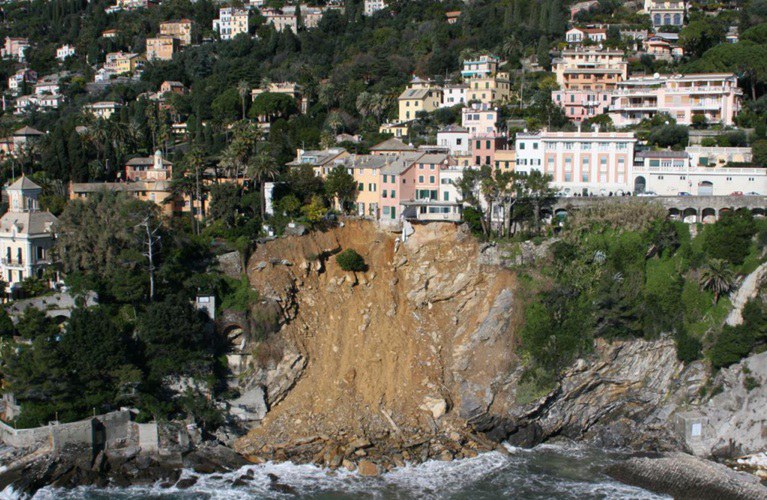
ISPRA presents the fourth report on hydrogeological instability in Italy: danger and risk indicators. Understanding the territory to prevent risks
The area of Italy at risk for landslides, as defined in the Hydrogeological Planning (PAI), has increased by 15%, from 55,400 km² in 2021 to 69,500 km² in 2024, equal to 23% of the national territory. The most significant increases were recorded in the Autonomous Province of Bolzano (+61.2%), Tuscany (+52.8%), Sardinia (+29.4%), and Sicily (+20.2%) and are primarily due to more detailed studies conducted by the district basin authorities and the autonomous provinces. The areas classified as highly at risk (high P3 and very high P4) have increased from 8.7% to 9.5% of the national territory. In 2024, 94.5% of Italian municipalities are at risk of landslides, floods, coastal erosion, or avalanches.
The situation on Italian beaches is improving: in terms of coastal erosion, there are more advancing stretches (+30 km) than eroding ones.
This is the picture that emerges from the fourth ISPRA Report on "Hydrogeological Instability in Italy" - 2024 Edition - the Institute's three-year work presented this morning in Rome at the Multipurpose Hall of the Presidency of the Council of Ministers.
"A thorough understanding of landslide phenomena is the essential foundation for effective risk prevention and mitigation policies, but so is communication and information dissemination," stated ISPRA President Stefano Laporta. "Hydrogeological instability is not just a technical or structural issue; it affects the daily lives of each of us, the safety of our communities, and the prospect of a resilient environment. Active citizen involvement is essential; their contribution is invaluable on multiple fronts, from collecting timely reports from the local area to supporting the dissemination of information and participating in local emergency plans."
"The ISPRA report shows that 19.2% of the national territory is classified as being at greatest risk for landslides and floods, and Italy remains among the most exposed European countries in terms of landslides, with over 636,000 recorded landslides," stated ISPRA Director General Maria Siclari. "Indicators and maps on hydrogeological instability are taking on an increasingly important role also in the field of sustainable finance, assessment and management of physical and financial risks associated with the economic impact of extreme natural events," explained the Director General. "ISPRA data on hydrogeological instability are a fundamental tool to support public policies and strategic plannig".
Hydrogeological instability in Italy: hazards and risk indicators. 2024 Edition
- https://www.isprambiente.gov.it/en/archive/ispra-events/2025/07/ispra-presents-the-fourth-report-on-hydrogeological-instability-in-italy-danger-and-risk-indicators
- ISPRA presents the fourth report on hydrogeological instability in Italy: danger and risk indicators. Understanding the territory to prevent risks
- 2025-07-30T09:00:00+02:00
- 2025-07-30T13:30:00+02:00
- The area of Italy at risk for landslides, as defined in the Hydrogeological Planning (PAI), has increased by 15%, from 55,400 km² in 2021 to 69,500 km² in 2024, equal to 23% of the national territory. The most significant increases were recorded in the Autonomous Province of Bolzano (+61.2%), Tuscany (+52.8%), Sardinia (+29.4%), and Sicily (+20.2%) and are primarily due to more detailed studies conducted by the district basin authorities and the autonomous provinces. The areas classified as highly at risk (high P3 and very high P4) have increased from 8.7% to 9.5% of the national territory. In 2024, 94.5% of Italian municipalities are at risk of landslides, floods, coastal erosion, or avalanches. The situation on Italian beaches is improving: in terms of coastal erosion, there are more advancing stretches (+30 km) than eroding ones. This is the picture that emerges from the fourth ISPRA Report on "Hydrogeological Instability in Italy" - 2024 Edition - the Institute's three-year work presented this morning in Rome at the Multipurpose Hall of the Presidency of the Council of Ministers. "A thorough understanding of landslide phenomena is the essential foundation for effective risk prevention and mitigation policies, but so is communication and information dissemination," stated ISPRA President Stefano Laporta. "Hydrogeological instability is not just a technical or structural issue; it affects the daily lives of each of us, the safety of our communities, and the prospect of a resilient environment. Active citizen involvement is essential; their contribution is invaluable on multiple fronts, from collecting timely reports from the local area to supporting the dissemination of information and participating in local emergency plans." "The ISPRA report shows that 19.2% of the national territory is classified as being at greatest risk for landslides and floods, and Italy remains among the most exposed European countries in terms of landslides, with over 636,000 recorded landslides," stated ISPRA Director General Maria Siclari. "Indicators and maps on hydrogeological instability are taking on an increasingly important role also in the field of sustainable finance, assessment and management of physical and financial risks associated with the economic impact of extreme natural events," explained the Director General. "ISPRA data on hydrogeological instability are a fundamental tool to support public policies and strategic plannig". Press release (ita) Program Hydrogeological instability in Italy: hazards and risk indicators. 2024 Edition IdroGEO Photo gallery
- When Jul 30, 2025 from 09:00 AM to 01:30 PM (Europe/Berlin / UTC200)
- Where Rome, Multipurpose Hall of the Presidency of the Council of Ministers, Via Santa Maria in Via 37 A
-
Add event to calendar
 iCal
iCal
Presentations
Relazione introduttiva
M. Siclari, ISPRA
I dati su frane e valanghe
A. Trigila, ISPRA
L’erosione costiera nel monitoraggio nazionale di ISPRA
F. D'Ascola, ISPRA
La piattaforma nazionale IdroGEO
C. Iadanza, ISPRA
Valutazione e gestione del rischio di alluvioni: il processo di aggiornamento
M. Bussettini, ISPRA
I dati del Repertorio Nazionale degli interventi per la Difesa del Suolo
P.L. Gallozzi, ISPRA