
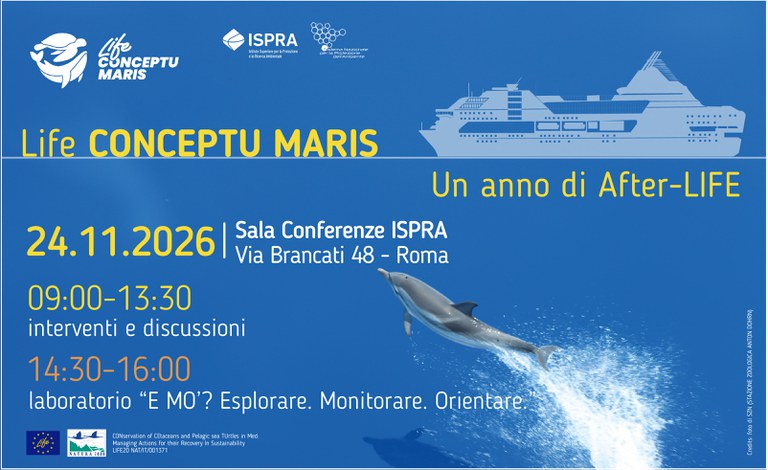
Life Conceptu Maris. One Year of After-LIFE
From project results to the continuity of actions: long-term monitoring, biodiversity conservation and decision support
During the first year of the After-LIFE phase (2026), CONCEPTU MARIS continues its activities in marine megafauna monitoring, biodiversity conservation and environmental policy support, building on the project's legacy.
Key achievements in 2026 include new seasonal distribution and habitat models for Caretta caretta (loggerhead sea turtle) and Tursiops truncatus (common bottlenose dolphin), the first evidence of the pygmy sperm whale in the Mediterranean through environmental DNA, and new insights into Mola mola (ocean sunfish)
- https://www.isprambiente.gov.it/en/ispra-events/life-conceptu-maris-one-year-of-after-life
- Life Conceptu Maris. One Year of After-LIFE
- 2026-11-24T09:00:00+01:00
- 2026-11-24T16:00:00+01:00
- From project results to the continuity of actions: long-term monitoring, biodiversity conservation and decision support During the first year of the After-LIFE phase (2026), CONCEPTU MARIS continues its activities in marine megafauna monitoring, biodiversity conservation and environmental policy support, building on the project's legacy. Key achievements in 2026 include new seasonal distribution and habitat models for Caretta caretta (loggerhead sea turtle) and Tursiops truncatus (common bottlenose dolphin), the first evidence of the pygmy sperm whale in the Mediterranean through environmental DNA, and new insights into Mola mola (ocean sunfish)
- What evidence
- When Nov 24, 2026 from 09:00 AM to 04:00 PM (Europe/Berlin / UTC100)
- Where Rome, ISPRA, via Vitaliano Brancati 48
-
Add event to calendar
 iCal
New developments have also emerged in the field of marine litter and in the identification of priority areas for mitigating anthropogenic pressures. Monitoring activities are continuing thanks to the renewal of agreements with FLT Med Net and shipping companies. Data collected from ferries will also be integrated with those obtained through aerial surveys. Citizen science activities and public engagement initiatives are also ongoing.
The challenge ahead is to translate the knowledge acquired into concrete conservation actions, strengthening existing partnerships and developing new LIFE and Interreg projects. This shared journey involves an ever-growing network of stakeholders, committed to identifying new opportunities for collaboration and action to protect Mediterranean megafauna and the marine heritage of the Mediterranean Sea.
The event will be held both in person and online via Google Meet. Registration is required only for those attending in person.