Wildfires: When Fire Erases Green
Understanding the impacts to protect forests: prevention starts now.
ISPRA updates wildfire data.
Wildfires in Europe and Italy
According to the European Forest Fire Information System (EFFIS), the 2026 wildfire season remains severe across Europe, particularly in Spain, France, Italy, Croatia and Belgium.
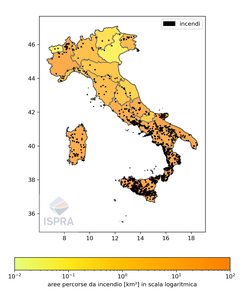
Between 1 January and 15 September 2026, Italy recorded 2,076 major wildfires, burning over 1,200 km², an area almost as large as Rome’s municipal territory. Nearly 200 km² of the burned land consisted of forests.
Sicily was the hardest-hit region, accounting for 55% of Italy’s total burned area, followed by Calabria and Puglia, each representing around 10%. Piedmont was the most affected region in northern Italy, while Abruzzo led in central Italy, both accounting for approximately 4%.
Agrigento was the most severely affected province, with 222 km² burned, including around 15 km² of forest.
Protected areas were particularly vulnerable: over 30% of Italy’s total burned area and approximately 40% of burned forest land fell within national parks, nature reserves and Natura 2000 sites.
Major wildfire events
On 20 July, a large fire in the provinces of Agrigento and Palermo burned 63 km², including 12 km² of forest, mainly evergreen woodland and conifer plantations, much of it within ecologically valuable areas.
On 4 August, another serious fire affected Piedmont’s Biella and Vercelli provinces, burning approximately 9 km² of forest, primarily mixed deciduous and coniferous woodland.
Monitoring and prevention
ISPRA’s wildfire monitoring system uses high-resolution satellite observations to provide scientifically reliable data, helping national and regional authorities assess environmental damage and improve forest protection and prevention strategies.
Maria Alessandra Gallone, President of ISPRA and SNPA:
“Today, we have data and knowledge that enable us to better understand the scale of wildfires, the damage they cause, and their impacts on ecosystems, biodiversity and the land. We know what we are facing and the consequences of fire for our natural heritage.
This knowledge must be translated into concrete action. We have the months leading up to next summer to strengthen prevention, improve emergency response capabilities and promote more responsible land management.
New technologies can be essential allies in wildfire prevention and management. Drones, combined with satellite observation systems and environmental data analysis, can improve our understanding of the territory, help identify critical situations promptly, and monitor areas affected by fire. They can also help assess environmental impacts and guide subsequent interventions.
Strengthening cooperation between institutions and local authorities is essential. Mayors must not be left alone to face such a complex challenge; they need access to reliable data, scientific and technical expertise, and qualified support to make informed decisions.
ISPRA can contribute to this effort by sharing its extensive data resources, monitoring activities and expertise in ecosystem observation.
Prevention cannot be improvised when the flames arrive. It must be built beforehand through scientific knowledge, planning, and cooperation between institutions, local communities and citizens".
All data can be accessed and downloaded from ISPRA’s Ecosystems and Wildfires in Italy webpage.
Terrestrial Ecosystems and Wildfires in Italy: 2026 Fire Season — Report (PDF)