
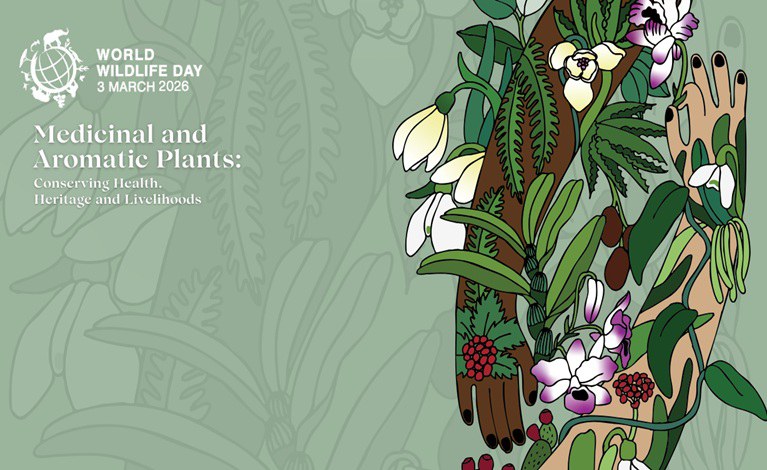
World Wildlife Day 2026
On December 20, 2013, at its 68th session, the United Nations General Assembly proclaimed March 3 as World Wildlife Day. This day is important because it commemorates the date in 1973 when the Convention on International Trade in Endangered Species of Wild Fauna and Flora (CITES) was signed.
The theme chosen for the 2026 observance is “Medicinal and aromatic plants: safeguarding health, heritage, and livelihoods”
Medicinal and aromatic plants (MAPs) are essential for both human health and ecological balance. The World Health Organization (WHO) recognizes their importance, particularly in developing countries, where 70–95% of the population relies on traditional medicine for primary healthcare. These plants form the foundation of many healthcare systems and remain vital to modern pharmaceuticals, as many active compounds are derived directly or indirectly from natural sources, despite advances in synthetic chemistry.
- https://www.isprambiente.gov.it/en/news/world-wildlife-day-2026
- World Wildlife Day 2026
- 2026-03-03T00:00:00+01:00
- 2026-03-03T23:59:59+01:00
- On December 20, 2013, at its 68th session, the United Nations General Assembly proclaimed March 3 as World Wildlife Day . This day is important because it commemorates the date in 1973 when the Convention on International Trade in Endangered Species of Wild Fauna and Flora (CITES ) was signed. The theme chosen for the 2026 observance is “Medicinal and aromatic plants: safeguarding health, heritage, and livelihoods” Medicinal and aromatic plants (MAPs) are essential for both human health and ecological balance. The World Health Organization (WHO) recognizes their importance, particularly in developing countries, where 70–95% of the population relies on traditional medicine for primary healthcare. These plants form the foundation of many healthcare systems and remain vital to modern pharmaceuticals, as many active compounds are derived directly or indirectly from natural sources, despite advances in synthetic chemistry.
- When Mar 03, 2026 (Europe/Berlin / UTC100)
-
Add event to calendar
 iCal
iCal
Medicinal and aromatic plants also contribute to various industrial sectors, including cosmetics, food, and luxury goods. Genetic resources derived from medicinal and aromatic plants and traditional knowledge about MAPs have been used for a wide range of applications in agriculture, medicine, and conservation. Ensuring the fair sharing of benefits arising from this use is essential and can provide incentives for the conservation and sustainable use of wildlife (Target 13 of the Kunming–Montreal Global Biodiversity Framework).
In addition, MAPs play a crucial role in supporting ecosystems by stabilizing soils, promoting biodiversity, and providing essential resources for pollinators such as bees and hummingbirds. However, many of these valuable species face increasing threats due to habitat destruction, climate change, overexploitation, and illegal trade, making their conservation a global priority.