
Publications
Reticula n.42/2026
Manual for the Application of Appropriate Assessment (AA) Procedures in Marine Sites
This volume provides a methodological guide for professionals, technical experts, and Public Administrations involved in the protection of marine and coastal biodiversity. The Manual was developed within the framework of the LIFE SEA.NET project, “Urgent Actions for the Implementation of the Marine Natura 2000 Network” (LIFE20 GIE/IT/000763), with the aim of supporting the initiatives of the Italian Ministry for the Environment and Energy Security in strengthening and optimizing the application of the Appropriate Assessment (AA) procedure in marine and coastal-marine sites of the EU Natura 2000 Network
Handbook Monitoring marine macro-fauna using ferries/large vessels as multidisciplinary research platforms
These Guidelines were developed within the framework of major European collaborative initiatives, including the LIFE Programme project Conceptu Maris, and the subsequent After-LIFE roadmap, the Fixed Line Transect -Mediterranean Monitoring Network and the IMPEL FLT-Maritime Transborder Transects networking initiatives.
Reticula n.41/2026
Environment in Italy: An Overview, 2025 Environmental Data Yearbook
Environment in Italy: An Overview, 2025 Environmental Data Yearbook is a statistical report that provides an up-to-date and scientifically grounded overview of the state of the environment in Italy. The document uses more than 300 indicators included in the ISPRA Environmental Indicators Database to provide official information for policy makers, administrators, technical experts, and citizens.
Report on the State of Water in Italy: Towards the Fourth Management Cycle
The report presents an assessment of the qualitative and quantitative status of water bodies in Italy, based on data from WISE reporting to the European Commission (EC) concerning the River Basin Management Plans of the third implementation cycle of the Water Framework Directive 2000/60/EC. The data were collected with the contribution of River Basin Authorities, Regions, and Regional (ARPA) and Provincial (APPA) Environmental Protection Agencies.
Educate, Communicate, Connect – The educational format of the LIFE SIC2SIC project
ISPRA has published “Educate, Communicate, Connect – The educational format of the LIFE SIC2SIC project,” which retraces an environmental education experience carried out in 48 schools involving more than 4,200 students.
Ecological Networks in Regional Spatial Planning Instruments. Report 2025
This Report presents and systematizes the results of the survey and analytical work undertaken to define the current state of the art regarding the implementation of Ecological Networks within the planning instruments and regulatory frameworks of the Italian Regions and Autonomous Provinces.
RETICULA n. 40/2025 Monographic Number
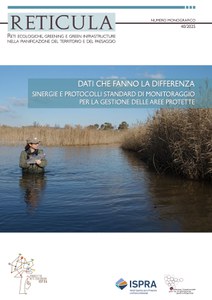
Data that make the difference: synergies and standard monitoring protocols for the management of protected areas
Guidelines for the rescue and rehabilitation of bats
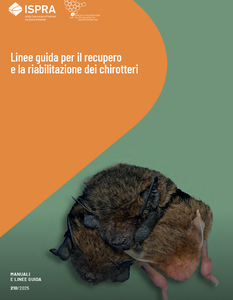
These guidelines constitute a technical and methodological reference framework for all wildlife rescue centers and provide updated and uniform guidance on the proper procedures for managing bats during the recovery and rehabilitation of individuals found in distress
The State of the Environment in Italy 2025: Indicators and Analysis
The report The State of the Environment in Italy 2025: Indicators and Analysis, produced by the Italian Institute for Environmental Protection and Research (ISPRA), provides an updated and integrated overview of the main environmental dynamics in the country. The analysis is based on a selection of indicators drawn from the ISPRA Environmental Indicators Database ( https://indicatoriambientali.isprambiente.it/it ).
Guidelines for the preparation of environmental impact studies relating to agrivoltaic and photovoltaic systems
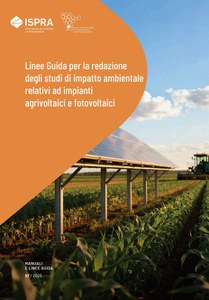
The Guidelines represent a technical and methodological reference tool for Environmental Impact Assessment (EIA) preparers and enable well-structured EIAs, resulting in a faster evaluation phase: complete EIAs require fewer integration requests, fewer environmental conditions, and therefore, faster environmental permitting processes.
Reticula n.39/2025
Towards a Monitoring & Evaluation framework for international environmental cooperation: the Italian Ministry of Environment and Energy Security as a case-study
The present publication titled "Towards a Monitoring & Evaluation framework for international environmental cooperation: the Italian Ministry of Environment and Energy Security as a case-study", is the result of an operational agreement between ISPRA and the Italian Ministry of Environment and Energy Security (IMEES) signed in 2021.
Atlas 2025. Territories in Transformation
Reticula n.38/2025
Environment in Italy: An Overview, 2024 Environmental Data Yearbook
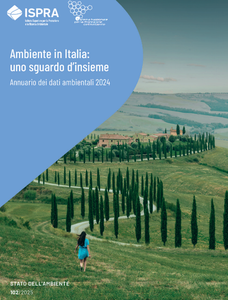
Environment in Italy: An Overview, 2024 Environmental Data Yearbook is a statistically significant and scientifically relevant report produced by the Italian Institute for Environmental Protection and Research (ISPRA), in collaboration with regional and autonomous provincial Environmental Protection Agencies, as part of the National System for Environmental Protection (SNPA).
Reticula n. 37/2024 Monographic Number
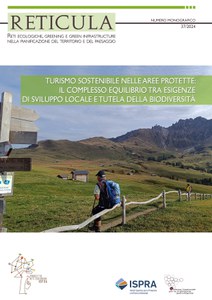
Sustainable tourism in Protected areas: the complex balance between local development needs and biodiversity conservation
Monitoring potentially toxic Ostreopsis cf. ovata along the italian coasts. Year 2023.
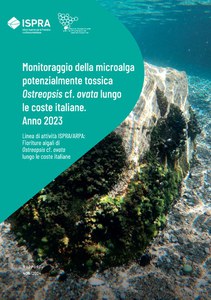
Working Programme ISPRA/ARPA: Ostreopsis cf. ovata blooms along the italian coasts. The presence of the potentially toxic dinoflagellate Ostreopsis ovata (Fukuyo) has been observed along the Italian coast since the ‘90s. From then, intense and recurrent blooms of this seaweed alga occurred in several locations of the Tyrrhenian Sea and Adriatic Sea. The presence of the microalgae O. ovata was detected in all the Italian coastal regions but Emilia-Romagna and Molise.
Guidelines for the conservation of Mediterranean trout and its habitat in protected areas and Natura 2000 sites
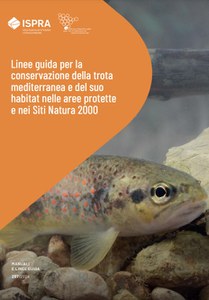
The Mediterranean trout, included in Annex II of the Habitats Directive 92/43/EEC, is a key species of aquatic ecosystems for its role at the top of the trophic networks of the Apennine, island and hill mountain watercourses.
Urban nature Plans: tools to bring nature back into our lives?
Environment in Italy: an overview. Environmental Data Yearbook 2023
Environment in Italy: an overview. Environmental Data Yearbook 2023 is a statistical report produced by the Italian Institute for Environmental Protection and Research(ISPRA) in collaboration with the regional and autonomous province environmental protection agencies as part of the National System for Environmental Protection (SNPA).
Reticula n.36/2024
Atlas of Environmental Data. Edition 2024
The Atlas of environmental data, a volume that ISPRA publishes in this new edition, which offers an overview and a selection of the main environmental data in Italy. It provides cartographic representations that show the distribution of the main environmental information on the territory which, together with graphs, tables and texts, illustrate the situation of our country.
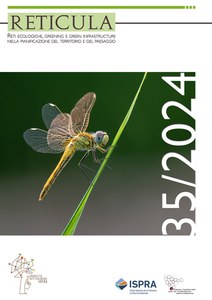
Reticula n.35/2024
Forgotten fruits and recovered biodiversity. The fruit and vine germoplasm of traditional Italian agriculture. Case studies: Marche and Tuscany
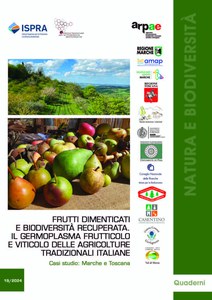
The volume, tenth and last in the series dedicated to the study of some of the Italian fruit varieties, deals with the case studies of Marche and Tuscany. For both regions, in the initial chapters, historical notes are provided relating to fruit growing, agricultural landscape, and the various initiatives aimed at the recovery, protection and valorisation of genetic resources still present in the form of fruit varieties that are rarely grown and at risk of disappearing.
Quaterly bulletin on a research funding
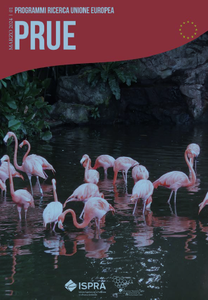
Directive against greenwashing. Parliament has given its final green light to a directive that will improve product labelling and ban the use of misleading environmental claims.
Operating procedure for the solid phase assay using Aliivibrio fischeri
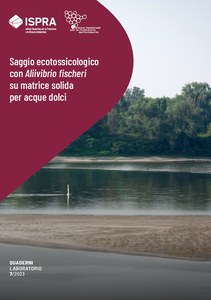
This document describes the outcomes of a collaborative trial on ecotoxicological measurements in which laboratories belonging to public institutions (ISPRA, ARPA/APPA, Universities and other Research Institutes) and private subjects participated. This study led to the validation of a specific method for freshwater environments for conducting the solid-phase bioassay using the bacterium Aliivibrio fischeri.
Towards resilient cities: the interventions of the experimental Program for adaptation to climate change in urban areas
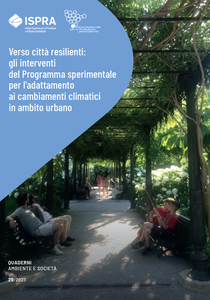
This Booklet offers an overview of the actions proposed by the Italian municipalities participating in the experimental program of interventions for adaptation to climate change in urban areas, launched in 2021 by the Ministry of Ecological Transition (now the Ministry for the Environment and Energy Security), in collaboration with ISPRA and ANCI.
Reticula n. 34/2023
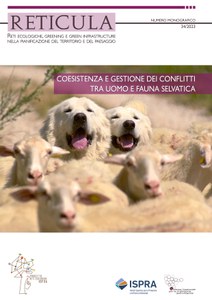
Coexistence and management of human-wildlife conflicts