
Air
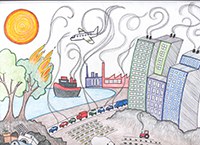
The air pollution is produced by the indoor or outdoor environmental contamination by chemical, physical or biological agents that modify the natural characteristics of the atmosphere. The machine for the homes heating, the engines of vehicles, industrial plants and forest fires are common sources of air pollution. Pollutants that have great impacts on public health are particulate matter (PM10), carbon monoxide (CO), ozone (O3), nitrogen dioxide (NO2) and sulfur (SO2).
Air pollution is harmful to human health and the environment. In Italy, emissions of many air pollutants have significantly decreased in recent decades, with consequent improvement of air quality; however, the concentrations of air pollutants are still too high and the air quality pollution persist. This also happens because the report between emissions (what comes from car exhaust pipes or chimneys of houses and industries) and concentrations of pollutants in the atmosphere (which describe the quality of air that people breathe) is not generally direct and linear : the concentration observed and its variability in time and space depend in fact, in addition to the load-emissivity, by other factors, related to meteorology and the chemical reactivity. This is example is specific for PM10, (O3), (NO2) that in part or all, are formed in the atmosphere from other substances called "precursors". Therefore it is necessary to estimate the emissions, through the inventories of emissions into the atmosphere, and measure the concentrations to assess the air quality in order to study phenomena and plan a series of measures and actions to be taken by means of plans and programs to contrast air pollution.
ISPRA main activities
- Emissions. The national inventory of air emissions permits to identify the main sources of emissions at the national level and to describe trends during time.
- Air Quality. ISPRA organizes and makes available the national air quality data available that collects within the European Information Exchange (Exchange of Information, EoI).
- Plans for air quality and plans to reduce air pollution impacts on cultural heritage.
-
Oct 21, 2026Greenhouse Gas Emissions Fall by 1.5% in 2026 as GDP Grows
-
Pizzo CalabroOct 21, 2026 — Oct 22, 2026The Environment as a Source of Healing
-
Apr 15, 2026Air Quality in Italy: Stable Values in 2025
-
Aula Magna Palazzo Bernabei, Università degli Studi di Perugia, Sede di Assisi and onlineMar 19, 2026 09:30 AM — Mar 19, 2026 01:30 PMPollen in Space
-
Mar 06, 2026Pollen Monitoring in Italy: Insights from the CAMS NCP Survey
- Disaggregation of the national emissions inventory at the provincial level
- Greenhouse gas emissions in Italy: reduction targets and emission scenarios. Edition 2026
- Environment in Italy: An Overview, 2025 Environmental Data Yearbook
- National Inventory Document 2026. Italian Greenhouse Gas Inventory 1990-2024
- Italian Emission Inventory 1990-2024. Informative Inventory Report 2026
- The State of the Environment in Italy 2025: Indicators and Analysis
- Efficiency and decarbonization indicators in Italy and in the biggest European Countries – Edition 2025
- Atlas 2025. Territories in Transformation
- Environment in Italy: An Overview, 2024 Environmental Data Yearbook
- Greenhouse gas emissions in Italy: reduction targets and emission scenarios