
News
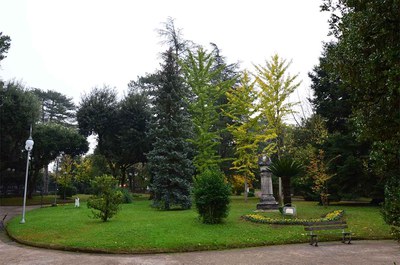
The National Biodiversity Network supporting the educational programme to explore the biodiversity of Benevento
Feb 11, 2026 — Feb 11, 2026On Wednesday, February 11, the educational programme dedicated to biodiversity, territory, and citizen science officially began, involving students from the Made in Italy High School and the Applied Sciences High School of the Guacci Institute in Benevento. The programme is carried out in collaboration with Futuridea – Territorial Innovation Laboratory and is supported by ISPRA’s National Biodiversity Network (NNB), which provides its infrastructure for data collection.
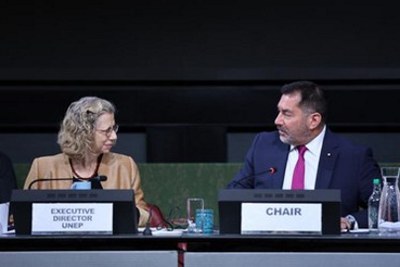
First Plenary Session of the Intergovernmental Science-Policy Panel on Chemicals, Waste and Pollution (ISP-CWP)
Feb 02, 2026 — Feb 06, 2026 GenevaThe first plenary session of the Intergovernmental Science-Policy Panel on Chemicals, Waste and Pollution (ISP-CWP), the new scientific intergovernmental body established by the United Nations, concluded on February 6, 2026, at the Geneva International Conference Centre (CICG). The panel focuses on the management of chemicals and waste and the prevention of pollution, and is dedicated to strengthening the science–policy interface in this field.
“Stop the clock” on environmental commitments?
Feb 18, 2026 02:00 PM — Feb 18, 2026 06:00 PM RomeBetween regulatory decisions and voluntary corporate commitments.
The event, which will take place in Rome on February 18, aims to provide an updated overview of the current state of implementation, as well as the future prospects, of regulations affecting the agri-forestry sector in particular.
The meeting will also be an opportunity to analyze the possible effects of delays in implementing some key European Green Deal regulations.

Circular Sea. On the route to sustainability: fifth and final episode of the podcast Tandem – Discovering Circular Italy.
Feb 16, 2026At the final stop, Edo and Marti cycle along the Apulian coast to talk about the sea. A plant considered “dirty” by tourists proves essential for protecting the coastline; plastic objects resurfacing after decades become clues to our past; a nature reserve shows how scientists, fishers, and local communities can work together to save sea turtles, seabeds, and habitats.
Tandem – Discovering Circular Italy is the podcast series that tells how sustainability and beauty can grow together thanks to the circular economy.
Tandem gives voice to the commitment of ISPRA and the Ministry of Enterprises and Made in Italy, which through the Facciamo Circolare campaign promote a more sustainable development model, where every daily choice can make a difference.

On February 27, a new Copernicus Land Monitoring Service training course will take place: Bio-geophysical Variables at the European scale
Feb 27, 2026 — Feb 27, 2026The Copernicus Land Monitoring Service (CLMS) is launching a new training course focused on Bio-geophysical Variables products at the European scale, with particular emphasis on HR-VPP, Water Bodies, Snow, and the EU-Hydro dataset.
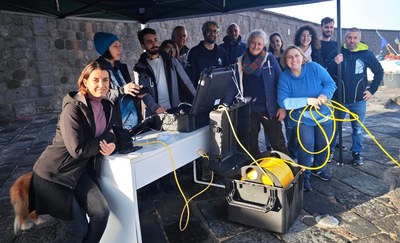
ROV pilot course aimed at some of the Marine Protected Areas within the DigitAP Project
Feb 09, 2026 — Feb 13, 2026 IschiaAs part of the DigitAP Project, one of the technical training sessions for ROV pilots concludes on February 13. The course, aimed at Marine Protected Areas and managed by specialized economic operators who won the tender, ensures the full operational readiness of the equipment delivered for the protection of our seas

Voice from environment
Feb 12, 2026Voce all’Ambiente is a podcast series made up of six weekly episodes, broadcast on Roma Tre Radio and available on Spotify. With an accessible and informal approach, the podcast gives a voice to ISPRA researchers, who share scientific findings, new regulations, and future perspectives on a range of environmental topics.
The project—conceived by Alessandra Casali with contributions from Chiara Bolognini (ISPRA), Marta Perrotta and Oriella Esposito (Roma Tre University), and with post-production support from Alessandro Saviantoni and Emanuela Favata—was developed within the Master’s program in Science and Research Communication (ComRiS) at Roma Tre University.
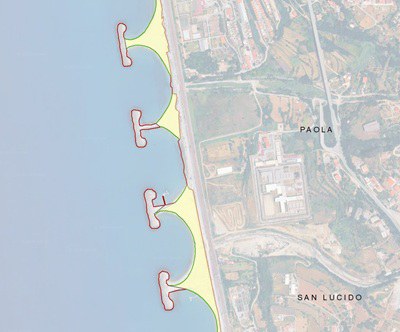
Rigid coastal defense works, a step forward in knowledge: the ISPRA geodatabase has been published
Feb 10, 2026Italy today has almost one fifth of its coastline affected by the presence of rigid coastal defense works: as of 2020, this amounted to more than 1,500 km of coastline, equal to 18%, representing a 27% increase compared to 2000 data—over 200 km of coastline. Calabria, more than other regions, has seen the length of coastline affected by these structures grow by 66%. From 2020 to today, following the same trend, an additional roughly 50 km would have been added.
Climate change has led to an increase in the frequency and intensity of extreme weather events, such as Mediterranean cyclones and storm surges; sea-level rise and alterations in wind and current regimes amplify wave energy, accelerating coastal erosion processes and increasing the vulnerability of already fragile coastlines. In this context, events such as Cyclone Harry, which recently struck the coasts of Sicily, Calabria, and Sardinia, are no longer isolated incidents but signs of a structural trend that adds to the effects of certain human activities and calls for increasingly integrated, evidence-based coastal adaptation and management strategies.
IPBES publishes a report on the links between business and biodiversity
Feb 09, 2026 — Feb 09, 2026On the occasion of the 12th plenary meeting of the Intergovernmental Science-Policy Platform on Biodiversity and Ecosystem Services, held in Manchester from 2 to 8 February 2026, the global methodological report “Business and Biodiversity: Methodological Assessment of the Impact and Dependency of Business on Biodiversity and Nature’s Contributions to People” was adopted. On the same occasion, the plenary also approved the Summary for Policymakers of the report.
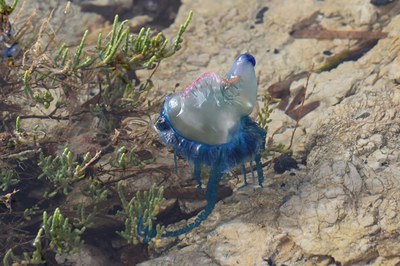
New sighting of a Portuguese man o’ war (Physalia physalis) in Favignana
Feb 07, 2026A new sighting of a Portuguese man o’ war (Physalia physalis) has been reported on the island of Favignana by a local citizen, who promptly informed the Egadi Islands Marine Protected Area. The MPA immediately alerted ISPRA researchers, initiating the procedures for the recovery and preservation of the organisms for scientific analyses.
The Portuguese man o’ war is a colonial hydrozoan of Atlantic origin that can reach the Mediterranean through the Strait of Gibraltar, carried by ocean currents. In Italy, the most frequent reports come from Sardinia, the Pelagie Islands, and the Messina coastline.
The species is easily recognizable thanks to its pneumatophore, the floating structure visible at the surface, but it also has long, highly stinging tentacles. For this reason, it is essential to avoid contact and to report any sightings to the local Marine Protected Areas or to the dedicated email address alien@isprambiente.it, providing photographic or video documentation.
13th National Day for the Prevention of Food Waste
Feb 05, 2026 — Feb 05, 2026February 5 marks the National Day for the Prevention of Food Waste: halving food waste by 2030 is the goal set by the United Nations Agenda, also echoed by “#2030Calling,” the theme of the thirteenth National Day for the Prevention of Food Waste.
The 2030 Agenda (Target 12.3) aims to halve per capita food waste at the retail and consumer levels and to reduce losses along production and supply chains by 2030, compared to 2015. This key target, which supports food security and reduces pressure on natural resources, is crucial for sustainability.

Dronitaly 2026
Mar 11, 2026 — Mar 13, 2026Dronitaly, now in its eleventh edition, confirms itself as the leading event for the professional drone community. With the participation of leading Italian and international companies, the event represents a strategic platform for fostering dialogue and collaboration among operators, institutions, and sector stakeholders.
The event will explore new frontiers in environmental monitoring, showcasing practical examples of the use of drones for the acquisition and management of information in support of institutional decision-making processes. This will follow the entire operational value chain, from procedure management to surveying, data processing, and the delivery of information products.
On 11 and 12 March, ISPRA and SNPA are organizing the conference “The new ‘eyes’ of environmental monitoring: how technological innovation supports institutional Earth observation activities,” structured into two sessions.

Day of Women and Girls in Science
Feb 11, 2026 — Feb 11, 2026February 11 marks the eleventh International Day of Women and Girls in Science, promoted by the United Nations to encourage women’s participation in STEM disciplines—an acronym that in English refers to science, technology, engineering, and mathematics. In these fields, women’s presence is globally far more limited than that of men, from the crucial stages of education and training through to academic and professional careers. This is an issue that concerns everyone, because gender equality, women’s self-determination, and equal opportunities are essential elements for building a democratic, fair, and prosperous society, as envisioned by Goal 5 of the UN 2030 Agenda for Sustainable Development.
The theme of the International Day of Women and Girls in Science (IDWGIS) 2026 is “Synergizing artificial intelligence, social sciences, STEM, and finance: building an inclusive future for women and girls.” As societies grapple with widening inequalities, the integration of artificial intelligence (AI), social sciences, science, technology, engineering and mathematics (STEM), and finance is emerging as a four-pillar approach to accelerating inclusive and sustainable development.
The Traveler: Danger or Resource?
Feb 20, 2026 03:00 PM — Feb 20, 2026 05:30 PM Sapienza University of Rome and onlineThe Contribution of Bioethics to Regenerative Tourism
The role of the conscious traveler can constitute a sort of "public good." We create connections between the health of people, places, crops, animals, and knowledge.
ISPRA researcher Andrea Monaco will participate in the meeting with a presentation entitled "Inform yourself, think, travel. For sustainable and alien-free tourism, data on invasive species."
Published the Report "Ecological Networks in Regional Spatial Planning Instruments. Report 2025"
Feb 02, 2026This Report presents and systematizes the results of the survey and analytical work undertaken to define the current state of the art regarding the implementation of Ecological Networks within the planning instruments and regulatory frameworks of the Italian Regions and Autonomous Provinces.
This survey constitutes the first outcome of the activities carried out by ISPRA, with the support of a broad range of national-level stakeholders, on Ecological Networks, in implementation of Objective 3 of the National Biodiversity Strategy 2030.
More than twenty years after the publication of the 2003 APAT Guidelines Management of Areas of Functional Ecological Connectivity, ISPRA has initiated the necessary process to update the document supporting the implementation of ecological connectivity. This update responds not only to the evolution of the relevant strategic and regulatory framework, but also to emerging global challenges as well as to new approaches to the identification and implementation of Ecological Networks.
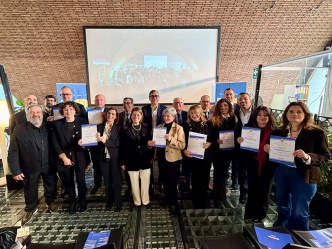
ISPRA Awarded at the PA OK! Contest for Management Innovation
Feb 02, 2026The ISPRA project “Innovating Public Administration Through Knowledge – The Sustainability Report as a Platform to Educate, Measure, and Generate Public Value” was awarded within the national PA OK! Contest – Together to Create Public Value, promoted by the Department of Public Administration and implemented by Formez PA as part of the NRRP (Mission 1).
During the award ceremony, held on 29 January 2026 in Rome, ISPRA received the special mention “Excellence for Citizens” in the Management Innovation category, as the project most voted for by citizens in this area. It also received the “PA OK! Award Finalist” mention, following its selection among 275 submitted projects, ranking among the top 10 projects in the Management Innovation area (modernization, human resources management, organizational improvement).

Tandem – Discovering Circular Italy
Feb 02, 2026“Natural Capital: The Economy of the Bee” is the title of the fourth episode of the podcast Tandem – Discovering Circular Italy.
Edo and Marti pedal from the Adriatic coast to the mountains of Abruzzo to understand what connects finance and biodiversity. From Pescara to Penne, all the way to Scanno, their journey leads them to meet researchers, experts, and people like beekeepers, who live every day alongside the pollinators that support our economy while asking nothing in return. A journey that reveals just how fragile and precious our biodiversity is—and how each of us can make a difference.
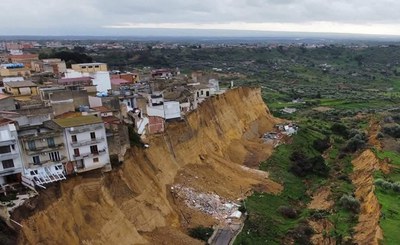
From Niscemi to the national landslide framework: ISPRA’s contribution through data and maps
Jan 28, 2026With a front extending for 4 kilometers and ground subsidence of several tens of meters along the crown, the sliding landslide that struck Niscemi in Sicily on January 25 is affecting the built-up area near the Sante Croci district and the provincial road SP10. The town of Niscemi is located on a plateau bounded, close to and along the edge of the urban area, by an escarpment. The outcropping materials consist of sands with sandstone layers, resting on clays.
The Sante Croci area had already been affected on October 12, 1997 by a large-scale landslide. The municipality of Niscemi has historically been impacted by landslide phenomena, as reported in the Italian Landslide Inventory (IFFI), which currently includes more than 684,000 landslides across the national territory. Geologists from the Sicilian Region – Hydrographic District Basin Authority of Sicily – are conducting field surveys to map the Niscemi landslide, in order to update the IFFI Inventory and the Hydrogeological Asset Plan (PAI).
ISPRA, in collaboration with the Regions and the Autonomous Provinces, carries out daily surveys of major landslide events and the damage they cause to buildings, cultural heritage, primary transport and communication infrastructure, and the economic and productive fabric, and publishes this information on the national IdroGEO platform.
IdroGEO is an easy-to-use tool, accessible even via smartphone, developed by the Institute with the aim of encouraging community involvement and raising awareness of the risks affecting local areas. Through the “Hazard Check” feature, users can search for an address or geolocate themselves on the map to identify the level of landslide and flood hazard within a 500-meter radius of a point of interest (home, business, or productive activity).
As part of its institutional mandate to collect, process, and disseminate data and maps on hydrogeological instability across the entire national territory, ISPRA publishes every three years the Report on Hydrogeological Instability in Italy, which represents the official reference framework on hydrogeological hazard and risk in the country. As highlighted by the latest report, presented last July, 94.5% of Italian municipalities are exposed to the risk of landslides, floods, avalanches, and/or coastal erosion; 19.2% of the national territory is classified as having higher landslide and flood hazard; 1.28 million people live in areas of high and very high landslide hazard; and 6.8 million people are exposed to flood risk under the medium hydraulic hazard scenario, with return periods between 100 and 200 years.
All data are made available to the country for the purposes of risk prevention and mitigation.
Within the framework of technological innovation, the Institute promotes the testing of innovative technologies for landslide monitoring, such as photo-monitoring based on the use of photographic sensors capable of documenting changes in the territory over time, as well as the use of Artificial Intelligence for the collection, analysis, and archiving of landslide-related information, and to improve the accessibility and usability of information for citizens on the IdroGEO platform through the implementation of a virtual assistant that interacts with users, providing information and answering questions on hydrogeological instability.
Hydrogeological instability in Italy: hazards and risk indicators. Edition 2024

Lotti 2026: One Hundred Years of Geological Research in Umbria
Feb 18, 2026 — Feb 20, 2026 SpoletoOne hundred years after the publication of Geological Description of Umbria by Bernardino Lotti, the conference “Lotti 2026: One Hundred Years of Geological Research in Umbria”, to be held in Spoleto from 18 to 20 February 2026, aims to retrace the evolution of geological knowledge of the Umbria–Marche region and to highlight the most recent developments as well as the issues that require further investigation. Umbria, in fact, has been and continues to be a natural laboratory for geology, and from here research has originated that has developed topics of general interest, including at a global scale.
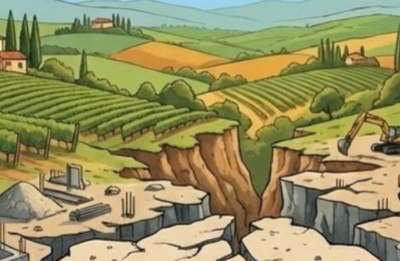
When the land disappears: the future we will not see
Feb 20, 2026 — Feb 20, 2026 Montevarchi (AR)The Upper Valdarno, an area that includes territories within fifteen municipalities across the provinces of Arezzo and Florence, has experienced significant land consumption over the past 20 years, both permanent and reversible.
The workshop will provide an opportunity to discuss land consumption, the recent flooding events that reflect the ongoing effects of climate change, and territorial restoration projects.
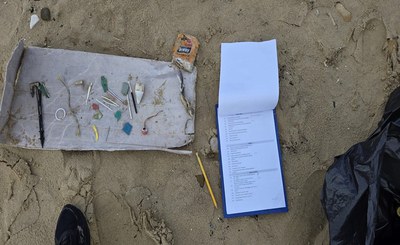
Field activities under the Revive Interreg Italy-Malta project have commenced
Jan 26, 2026ISPRA has begun field activities in the Gulf of Castellammare, where monitoring of stranded marine litter was carried out in accordance with the protocols of the Marine Strategy Framework Directive. Over 800 pieces of litter were cataloged and collected along 100 meters of beach. The next activity in this area is scheduled for spring.
The REVIVE Research Project aims to define effective intervention measures in the Italy-Malta cross-border area, with the goal of conserving biodiversity and restoring priority habitats, including sites within the Natura 2000 Network.
The project includes: the assessment of the status of habitats of interest (vermetid reefs, seagrass meadows), with a focus on the role of Invasive Alien Species and marine litter; passive and active restoration interventions based on the use of substrates or artificial structures to promote habitat recovery; and monitoring the effectiveness of these interventions. This monitoring will integrate traditional methods (such as visual censuses and scraping) with recently applied innovative techniques, such as eDNA metabarcoding. Furthermore, the role of floating marine litter in the transport of Invasive Alien Species within the study areas will be evaluated.
TAIEX-EIR multi-country Flagship workshop on the Soil Monitoring Law
Jan 27, 2026 — Jan 27, 2026 BruxellesThe "TAIEX-EIR multi-country Flagship workshop on the Soil Monitoring Law," organized by the European Commission on the Soil Monitoring Directive, will be held on January 27 in Brussels.

Tandem – Discovering Circular Italy
Jan 23, 2026“Let’s go in search of Green Jobs” is the central theme of the third episode of Tandem – Discovering Circular Italy, the podcast series that tells the story of how sustainability and beauty can grow together thanks to the circular economy.
From Milan to Turin, Edo and Marti explore how sustainability is already reshaping the world of work. In the Lombardy capital, they meet those who are rethinking design through an ecological lens, while among the farmsteads of the Novara area they discover a form of agriculture that regenerates the land instead of exploiting it. In Turin, along the corridors of a higher education institute, new questions emerge: what skills will be needed tomorrow? And how do we truly prepare for the future?
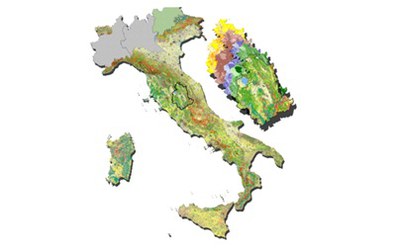
Natural Map: the map of the Umbria region is available
Jan 22, 2026As part of the work on the creation of Italy’s Nature Map, the update of the habitat map and the related ecological-environmental assessments for the Umbria region is now available on the ISPRA website.
The products were developed by ISPRA following the methodological review and the update of the Legend.
The updated map includes 111 different habitat types and 48,534 ecotopes.
The cartography can be viewed on the ISPRA Geoportal or requested free of charge in shapefile format through the dedicated online form.
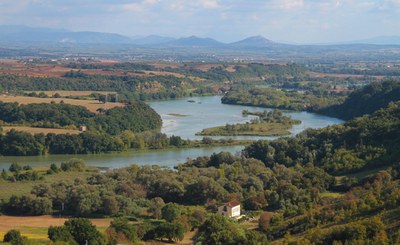
World Wetlands Day and the 50th anniversary of Italy’s ratification of the Ramsar Convention
Feb 02, 2026 — Feb 02, 2026 FAO, RomeOn the occasion of World Wetlands Day, established by the United Nations in 1997, Italy will mark a major double milestone on 2 February: World Wetlands Day and the 50th anniversary of Italy’s ratification of the Ramsar Convention on Wetlands of International Importance, signed in Ramsar, Iran, in 1971.
The theme chosen for World Wetlands Day 2026, “Wetlands and Traditional Knowledge: Celebrating Cultural Heritage,” aims to highlight the contribution of local communities and traditional knowledge to sustainable management practices and ecosystem restoration. This integrated approach, bringing together science, culture, and territory, is essential to counter the global decline of wetlands and to strengthen the resilience of natural systems.
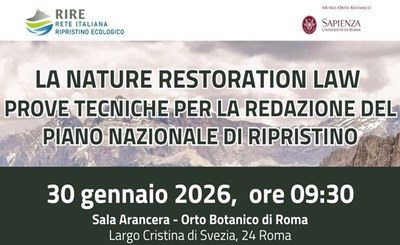
The Nature Restoration Law: technical evidence for the drafting of the national restoration plan
Jan 30, 2026 09:30 AM — Jan 30, 2026 05:00 PM Rome, Orto botanico and OnlineThe meeting will provide an opportunity for dialogue between European and Italian experiences, with the aim of promoting the exchange of good practices and critical reflections on the operational and knowledge-related challenges that lie ahead in the coming years.
The morning will be structured into two sessions. In the first session, the meeting will host (online) speakers from several European countries, who will share their approaches and strategies for drafting their National Restoration Plans. The discussion will focus on how each country is addressing key challenges—such as setting measurable targets, integrating biodiversity and climate objectives, ensuring effective governance, and engaging stakeholders. This comparative perspective will help highlight the diversity of national contexts and the overarching European vision underpinning the Nature Restoration Regulation.
The second session will be dedicated to the Italian context. Speakers involved in the preparation of the Italian National Restoration Plan will discuss the critical issues and opportunities of the ongoing process.
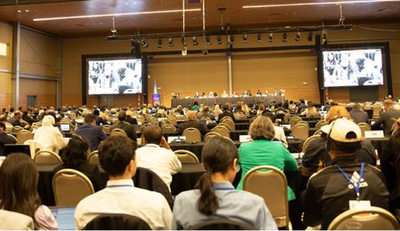
First session of the Plenary of the Intergovernmental Science-Policy Panel on Chemicals, Waste and Pollution (ISP CWP)
Feb 02, 2026 — Feb 06, 2026 Geneva, SwitzerlandFrom 2 to 6 February 2026, the first session of the Plenary of the Intergovernmental Science-Policy Panel on Chemicals, Waste and Pollution (ISP-CWP) will take place in Geneva, at the International Conference Centre (CICG). The ISP-CWP is a new UN-established intergovernmental scientific body focused on the management of chemicals and waste and the prevention of pollution, and is dedicated to strengthening the science–policy interface in this field.
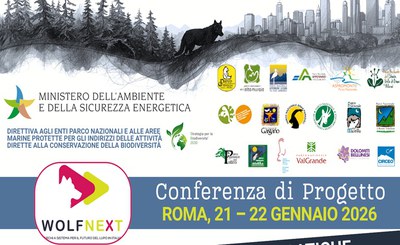
WOLFNETxT project conference
Jan 21, 2026 — Jan 22, 2026 Roma, Auditorium del Ministero dell'Ambiente e della Sicurezza Energetica"Research, Experiences, Best Practices. National Parks and the Wolf in Italy"
WOLFNExT is a network of National Parks that looks to the future of the wolf in Italy in light of the significant ecological changes that have driven the species' expansion into areas where it had disappeared for decades. These changes often create new interfaces, requiring appropriate and increasingly advanced operational capabilities. Last but not least, they suggest adaptive solutions and effective communication with various stakeholders.
Online the publication: "EMAS in the Construction Sector: Best Practices and Circularity"
Jan 19, 2026The construction sector plays a strategic role in the country’s economic development but also exhibits significant potential for improvement in terms of mitigating its environmental impacts, particularly in construction site management.